Building Resilience: Why CMMC and ISO 42001 Create Operational Advantages

Reframe CMMC and ISO 42001 compliance as operational resilience that creates genuine competitive advantages.
Reframe CMMC and ISO 42001 compliance as operational resilience that creates genuine competitive advantages.

Contractors misunderstand penetration testing's role in CMMC. Learn what's actually required and how to scope testing appropriately.

Vulnerability management in CMMC requires more than scanning and patching. Learn what C3PAO assessors test and what evidence demonstrates operating effectiveness.
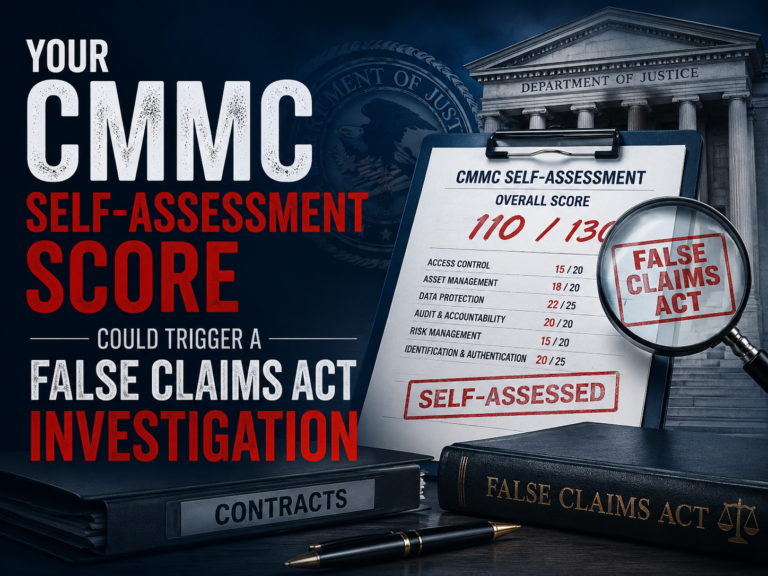
DoD contractors face False Claims Act exposure — up to millions in penalties — for inflated CMMC/NIST 800-171 self-assessment scores. Here's how the DOJ actually catches it, and what an accurate score really requires.

Should defense contractors pursue CMMC and ISO 42001 separately or integrate them? Learn how to design a single compliance program satisfying both.

Configuration management is commonly misunderstood in CMMC. Understand what's actually required: baselines, documentation, and verification.

Most contractors have an incident response plan but lack the documentation to prove it works. Learn what C3PAO assessors examine.

Access control failures are the most common reason contractors fail CMMC assessments. Learn exactly what C3PAO assessors examine and what documentation proves operating effectiveness.

Many ISO 27001-certified contractors assume their certification transfers to CMMC compliance. Learn the core differences between control-existence audits and operating-effectiveness audits.

CMMC Level 2 readiness is within reach for Tier 2 and Tier 3 defense contractors—but only if you follow a structured 90-day roadmap. This guide breaks down key controls, evidence requirements, and realistic timelines.