
The ISO 27001 CMMC evidence requirements gap is the single most expensive misunderstanding I encounter with certified defense contractors. The conversation usually starts the same way: “We’re already ISO 27001 certified. Isn’t CMMC just the US version?” No — and that assumption routinely costs contractors months of remediation work they didn’t budget for. If you hold an ISO 27001 certificate and your contracts put CMMC Level 2 in your future, this article explains exactly where your certification helps, where it doesn’t, and how to close the distance — a gap worth closing now, while the July 2026 pause on third-party assessments gives you runway instead of a deadline.
Two Audits, Two Fundamentally Different Questions
ISO 27001 is control-dense. It asks: do these controls exist? Your auditor reviews your ISMS, samples your documentation, confirms the risk treatment plan maps to Annex A, and verifies management commitment. It’s a legitimate and valuable exercise — but it’s fundamentally an audit of design.
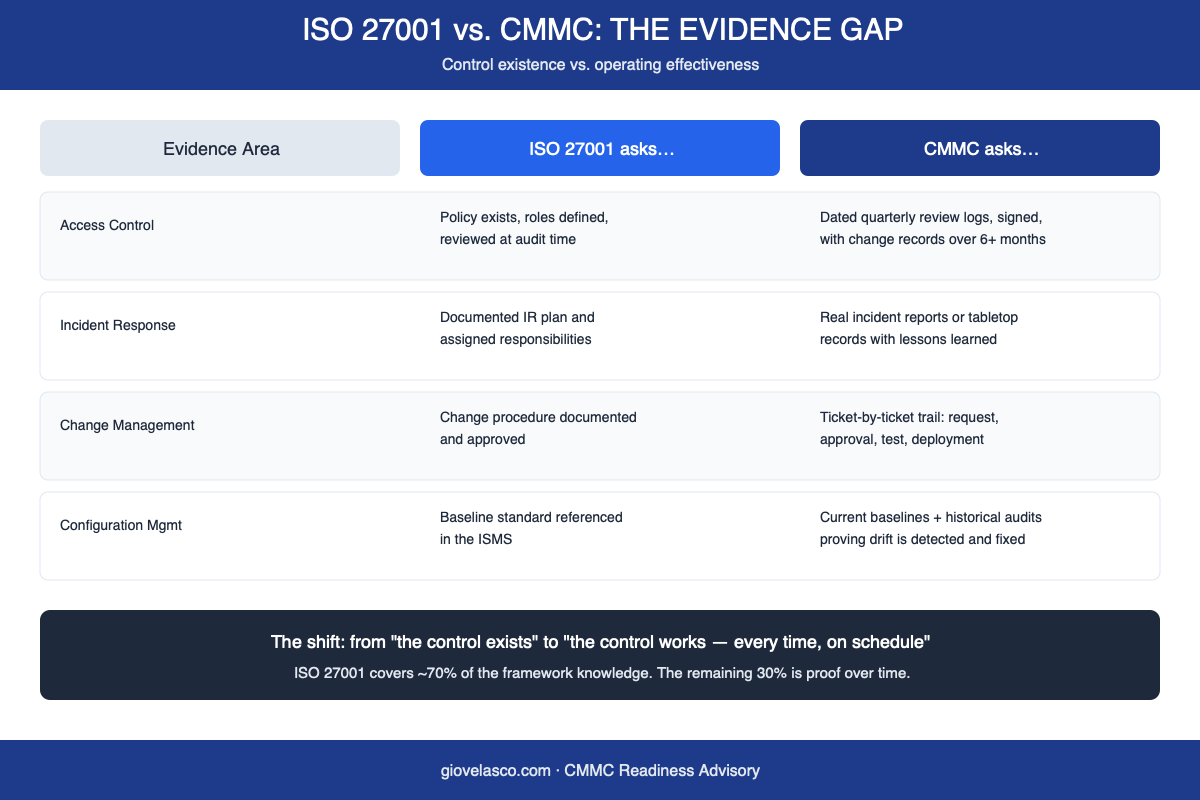
CMMC asks a harder question: do these controls work, consistently, every single time, under real operational conditions? A C3PAO assessor isn’t satisfied that your access control policy exists and was approved by management. They want the dated logs showing access was reviewed last quarter and the quarter before, who signed off, which exceptions were found, and what happened to them. ISO 27001 lets you document a control once. CMMC requires you to prove operating effectiveness over time.
This is why the certification doesn’t transfer. It’s not that the frameworks disagree about what good security looks like — they overlap heavily on substance. They disagree about what counts as proof.
Where the ISO 27001 CMMC Evidence Requirements Gap Actually Shows Up
Across the Tier 2 and Tier 3 contractors I’ve worked with who came in with an ISO foundation, the gaps cluster in four predictable places:
- Access control validation. ISO shops have the policy and the role definitions. What they’re missing is the recurring, documented review cycle — dated, signed, with exception handling — that CMMC treats as the control itself.
- Incident response documentation. An approved IR plan satisfies ISO. CMMC wants incident reports, investigation records, and lessons-learned write-ups from real events or documented tabletop exercises.
- Change management evidence. A documented change procedure is not the same as a ticket-by-ticket trail showing request, approval, testing, and deployment for every production change over months.
- Configuration management proof. ISO accepts a hardening standard referenced in the ISMS. CMMC wants current baselines plus historical audit records proving drift gets detected and corrected.
The Good News: You Already Know 70% of the Framework
If your organization genuinely operates an ISO 27001 ISMS — not a paper program, but a working one — you have real advantages walking into CMMC. You understand risk assessment as a discipline. You have a policy architecture. You have management review cadences, internal audit muscle, and a corrective action process. Those transfer directly.
The 110 practices in NIST SP 800-171 will look familiar because most map cleanly to Annex A territory: access control, cryptography, physical security, operations security, incident management. What you’re adding is not new security knowledge. It’s a shift in posture — from “the control exists and was audited” to “the control runs on a schedule and leaves a paper trail every time it runs.”
I tell clients to think of it as changing the deliverable. Under ISO, your deliverable was the ISMS. Under CMMC, your deliverable is the evidence library: an indexed collection of artifacts proving each of the 110 practices operated during the assessment window. Same underlying program, different product.
How to Measure Operating Effectiveness Before an Assessor Does
Here’s the practical test I run with every ISO-certified contractor starting CMMC work. Pick ten practices at random from 800-171. For each one, ask your team to produce, within one business day: the artifact proving the control ran in the last 90 days, the artifact proving it ran in the 90 days before that, and the name of the person accountable for it. Most first attempts produce complete evidence for three or four out of ten.
That number is your real readiness score — not your ISO certificate, not your policy count. And it points directly at the fix: for every practice that failed the test, either the control isn’t actually operating on a schedule (a process problem) or it operates but leaves no trail (an evidence problem). Process problems need remediation. Evidence problems need capture discipline: dated logs, named reviewers, stored artifacts. Both are solvable in a structured 90-day push — I’ve laid out that sequence in my CMMC Level 2 90-day roadmap.
A Realistic Transition Plan for Certified Contractors
For a contractor with a functioning ISO 27001 program, the transition typically runs 4 to 6 months. The sequence that works:
- Map your Annex A controls to the 110 NIST practices. Published crosswalks get you 80% of the way; the remaining 20% is where CUI-specific requirements like FIPS-validated cryptography live.
- Run the ten-practice evidence test described above across all domains to locate your real gaps.
- Convert one-time controls into cycles. Anything you did “for the audit” becomes something you do quarterly with a log.
- Build the evidence index. Practice number, artifact, location, date, owner. Your assessor experience lives or dies on this document.
- Mock-assess before you book. Interview your own people. If their answers don’t match the SSP, fix one or the other.
Don’t Let a Real Advantage Become a False Sense of Security
The ISO 27001 CMMC evidence requirements gap is closeable — faster for you than for a contractor starting from zero. But it closes through deliberate work, not through the certificate on your wall. The contractors who struggle are the ones who discover the gap during the assessment, at $15K–$30K per attempt. The ones who cruise through discovered it months earlier and spent the interval building evidence.
If you’re ISO-certified and want an honest read on how far you actually are from CMMC Level 2, that’s a one-conversation diagnosis. Schedule a discovery call and bring your Statement of Applicability — we’ll find your gaps before an assessor does.