
CMMC ISO 42001 operational resilience is the part of the compliance conversation nobody budgets for — and, in my experience, the part that ends up mattering most. Contractors approach both frameworks as costs: fees, consultant hours, staff time, all justified by contract access. That justification is real, but it undersells what actually happens inside an organization that builds these programs properly. The certificate is the receipt. The resilience is the product. This article reframes the compliance investment around the six operational advantages I watch emerge in contractor after contractor — advantages that persist whether or not an assessor ever returns.
The Reframe: Compliance as a Forcing Function
Here’s what CMMC actually forces an organization to do, stripped of the acronyms: know exactly what systems it runs and how they’re configured, control who can touch what, notice when something abnormal happens, respond to incidents with a rehearsed process, and keep records proving all of it. ISO 42001 forces the same discipline onto AI: know where models make decisions, monitor whether they still work, and keep humans accountable for outcomes.
Read that list again without the compliance framing. It’s simply how well-run operations look. The frameworks don’t invent these disciplines — they force the investment that operational leaders wanted anyway but could never win budget for. That’s the honest reason compliance produces resilience: it converts “we should really document our configurations someday” into a funded project with a deadline.
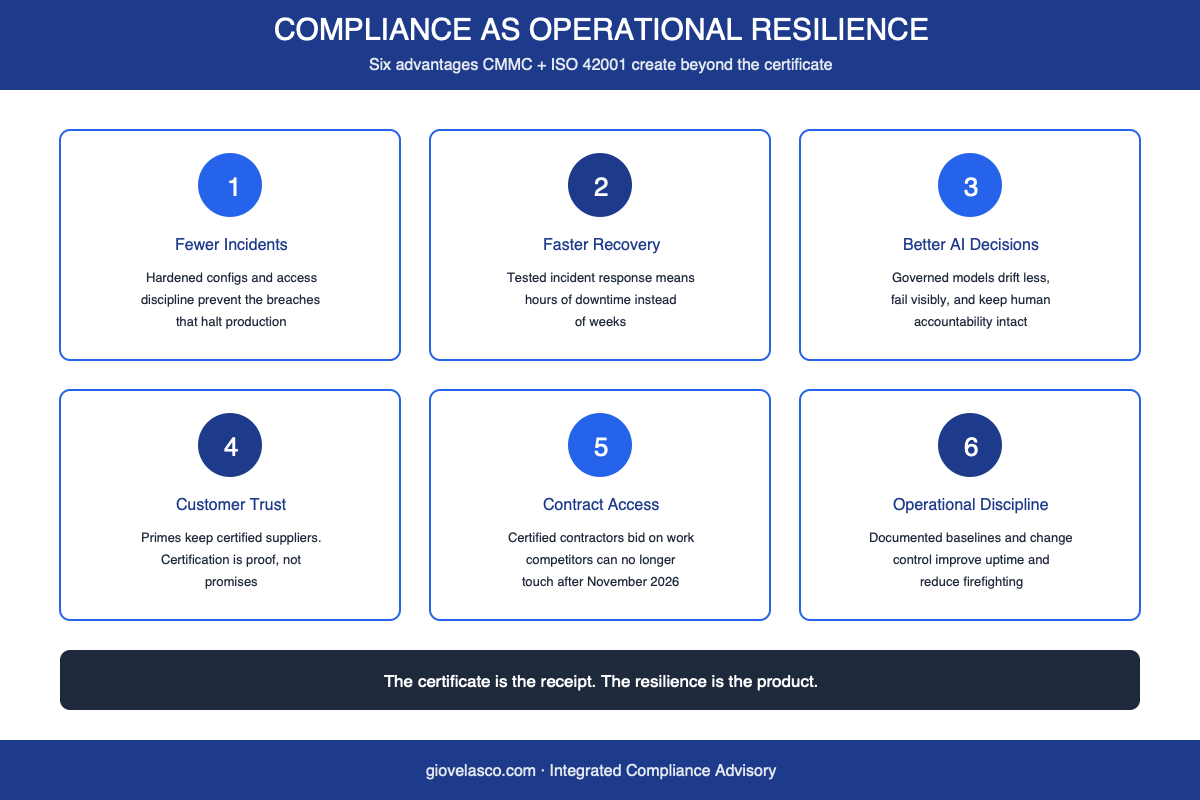
The Six Advantages of CMMC ISO 42001 Operational Resilience
- Fewer incidents. Hardened configurations, MFA everywhere, and access discipline don’t just satisfy practices — they close the doors that ransomware and credential-theft attacks actually walk through. Manufacturing downtime from a breach routinely costs more per week than an entire CMMC program.
- Faster recovery. A rehearsed incident response process with documented roles turns a potential multi-week crisis into a contained event. The tabletop exercises you ran for evidence are the reason the real incident stays small.
- Better AI decisions. Governed models drift less and fail visibly. The forecast model that would have quietly degraded for six months instead trips a monitoring threshold in week two — before it overcommits a production line.
- Customer trust that compounds. Primes consolidate their supply chains around suppliers who reduce their risk. Verified compliance is proof, not promises — and trust built on proof survives procurement reviews that promises don’t.
- Contract access competitors forfeit. With third-party certification paused since July 2026, primes have one way to separate suppliers: a defensible self-assessment backed by real evidence. Contractors who kept building win the CUI work their frozen competitors talk themselves out of — and when the reformed program lands, they walk in already done.
- Operational discipline as a habit. Documented baselines, change control, and scheduled reviews improve uptime and reduce firefighting everywhere they touch — including the systems that never see an assessor.
Why the Resilience Only Shows Up When You Build It Right
An important honesty check: paper programs produce none of this. A contractor who generates documentation for an assessment without changing how work happens gets the certificate and zero resilience — and usually loses the certificate at the next assessment cycle anyway, because paper programs decay. The resilience dividend comes specifically from the operating-effectiveness bar that makes CMMC hard: controls that run on schedules, leave evidence, and get audited. That’s the same bar I’ve described across this series, from access control evidence to configuration management — the evidence discipline isn’t bureaucratic overhead on top of the security; it is the mechanism that keeps the security real.
The research backs the pattern: organizations with tested incident response and mature security operations consistently show dramatically lower breach costs — IBM’s annual Cost of a Data Breach research puts the gap in the millions per incident. Rehearsal and discipline, not tooling, drive the difference. The frameworks force exactly those two things.
The Decision-Quality Dividend
The least obvious advantage deserves its own moment. Both frameworks force decisions into structures: risk gets assessed against criteria, changes get approved through workflows, exceptions get documented with expiry dates, AI outputs get human checkpoints. Organizations that live in these structures for a year make measurably better operational decisions — not because compliance made anyone smarter, but because the structures eliminate the failure modes of improvisation: the undocumented change nobody remembers, the risk everyone assumed someone else had accepted, the model output nobody questioned. Decision quality compounds quietly, and it’s the advantage competitors can’t see well enough to copy.
Capturing the Dividend Deliberately
If you’re building these programs now, three moves maximize the operational return. Extend deliberately: when you build change control for the CUI boundary, extending it to production systems costs little and pays daily. Measure the before and after: incident counts, mean recovery time, unplanned downtime — leadership funds what it can see improving. And keep the cycles alive after certification: the contractor who lets reviews lapse the month after passing converts a resilience asset back into a paper program, then pays to rebuild it in year three.
Compliance framed as a tax produces resistance and minimum effort. Framed as the forcing function for CMMC ISO 42001 operational resilience, it produces an organization that breaks less, recovers faster, decides better, and wins the work its frozen competitors talk themselves out of. If you want to build your program with the resilience dividend designed in from the start — not bolted on after the certificate — schedule a discovery call. Let’s make the investment pay twice.