
A CMMC ISO 42001 integrated compliance strategy answers the question I got three times this week alone: “Do we need to do both, or can we pick one?” They’re not competing frameworks. They’re complementary — CMMC governs how you protect controlled unclassified information, ISO 42001 governs how you manage the AI systems that increasingly touch that information. For defense contractors planning their 2026–2027 roadmap, the real question isn’t which one. It’s how to build both without paying for two full compliance programs. This article shows you the overlap, the sequencing, and the design pattern that makes one program satisfy two standards.
Why You Need Both — A Concrete Scenario
Imagine this: you’re a Tier 2 contractor using predictive analytics to forecast demand. That AI model processes historical data that includes CUI — contract quantities, delivery schedules, part specifications. CMMC governs how you protect that CUI: who can access it, how it’s encrypted, how access is logged and reviewed. ISO 42001 governs how the model makes decisions: whether its outputs are monitored for drift, who’s accountable when the forecast is wrong, and how you’d explain its behavior to a customer.
Neither framework covers the other’s territory. A perfectly CMMC-compliant environment can still run an ungoverned model that quietly degrades for six months. A beautifully governed model can still train on CUI stored with no access controls. The risk lives in the seam — and so does the requirement, because CMMC is mandatory if you handle CUI, and AI governance is rapidly becoming mandatory if you use AI in federal supply chains, as I detailed in my piece on ISO 42001 for defense contractors.
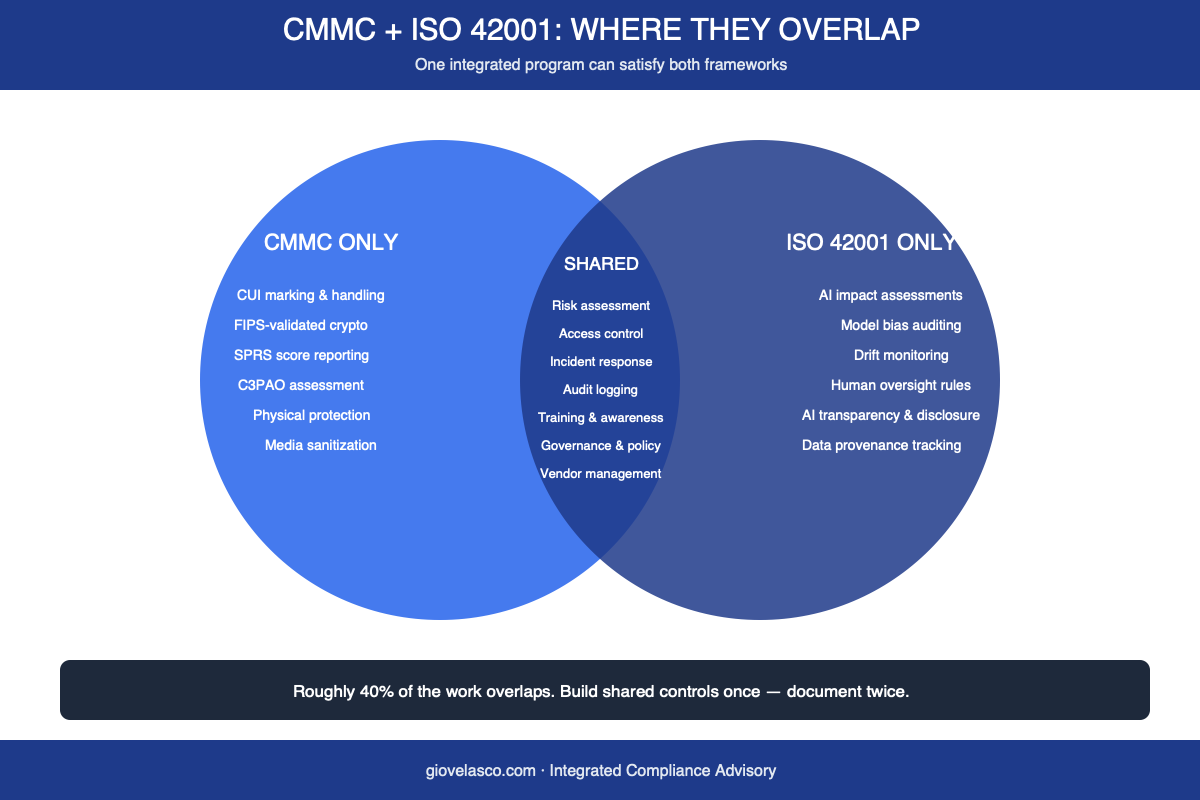
The Overlap: Roughly 40% of the Work Is Shared
When you map the two frameworks control by control, a substantial shared core emerges. Both require:
- Risk assessment as a recurring, documented discipline — CMMC for the CUI environment, ISO 42001 for AI systems. Same process, one added category.
- Access control — who reaches the data under CMMC, who reaches the models and training pipelines under ISO 42001. One role matrix covers both.
- Incident response — a security breach and a model failure need the same machinery: detection, escalation, documentation, lessons learned.
- Audit logging and monitoring — the log review habit CMMC forces is the same habit model monitoring needs.
- Training, governance, and vendor management — one awareness program, one policy architecture, one vendor review process, each with an AI module added.
In my engagements, that shared core consistently lands around 40% of total effort. Build it once, document it twice — once in your System Security Plan for CMMC, once in your AI management system documentation for ISO 42001. The remaining 60% splits into genuinely CMMC-only work (CUI marking, FIPS-validated cryptography, SPRS reporting, the C3PAO assessment itself) and genuinely ISO 42001-only work (AI impact assessments, bias auditing, drift monitoring, transparency documentation).
Designing the CMMC ISO 42001 Integrated Compliance Strategy
The design pattern that works is a single control library with framework mappings. Every control you operate — quarterly access reviews, change management, incident response exercises, risk assessments — lives once in the library, tagged with which framework(s) it satisfies and which evidence artifacts it produces. Your teams run one set of processes. Your documentation layer presents them in whichever framework’s language the auditor speaks.
This isn’t exotic. It’s how mature organizations already handle ISO 27001 plus SOC 2 plus HIPAA, and the pattern transfers directly. The alternative — two teams, two document sets, two audit calendars — costs roughly 70% more than integrated delivery and, worse, drifts: the two programs give different answers to the same question within a year, and auditors on both sides notice.
Sequencing: let CMMC lead. It has the hard deadline — November 2026 — and the heavier evidence burden, and its infrastructure is the foundation the AI program rides on. Run ISO 42001 one phase behind: while CMMC remediation is underway, do your AI inventory and policy; while CMMC evidence collection runs, do AI risk assessments; after your C3PAO assessment, decide whether market pressure justifies formal ISO 42001 certification or whether operating the framework un-certified is enough for now. That decision framework deserves its own article — and it has one coming later this summer.
Prioritization for Resource-Constrained Contractors
Most Tier 2 and Tier 3 contractors don’t have a compliance department — they have an IT manager with a second job. So prioritize ruthlessly. First: anything touching the CMMC deadline, because no certification means no new CUI contracts after November. Second: the shared 40%, because every hour there pays into both frameworks. Third: the “act now” quadrant of your AI risk assessment — especially any path where CUI could reach public AI tools, which is simultaneously a CMMC incident waiting to happen and an ISO 42001 governance failure. Fourth: everything else, on a schedule you can actually keep.
One practical tip from the field: when you write new CMMC-driven policies this year, add the AI clauses now. An acceptable-use policy that already prohibits CUI in unapproved AI tools, an incident response plan that already classifies model failures, a vendor questionnaire that already asks about AI features — these cost nothing extra to include while the documents are open, and they’re the seams where the integration actually happens. The ISO 42001 standard itself is worth having on hand while you draft.
Don’t Choose. Sequence.
The contractors who are smart right now aren’t choosing between frameworks — they’re building both on one spine, with CMMC setting the pace and ISO 42001 drafting behind it. The payoff shows up twice: once in avoided duplicate effort, and again in sales conversations, when you’re the supplier who can answer both the security questionnaire and the AI governance questionnaire while competitors are still deciding which program to start.
If you’re planning your 2026–2027 compliance roadmap and want to see what an integrated program would look like for your specific environment — control library, sequencing, budget — schedule a discovery call. One conversation, one integrated plan.