
AI governance standards future requirements are the theme of a prediction I’m willing to put my name on: ISO 42001 is just the beginning. In 12 to 18 months, we’ll start seeing sector-specific AI governance standards — defense contractors will face different requirements than healthcare providers, who will face different requirements than banks. If that sounds like more compliance burden coming, it is. But it’s also the clearest strategic argument for building your AI governance foundation now: the companies that move first adapt fastest to every wave that follows, while late movers restart from zero each time. This article maps the evolution I see coming and how to build for it.
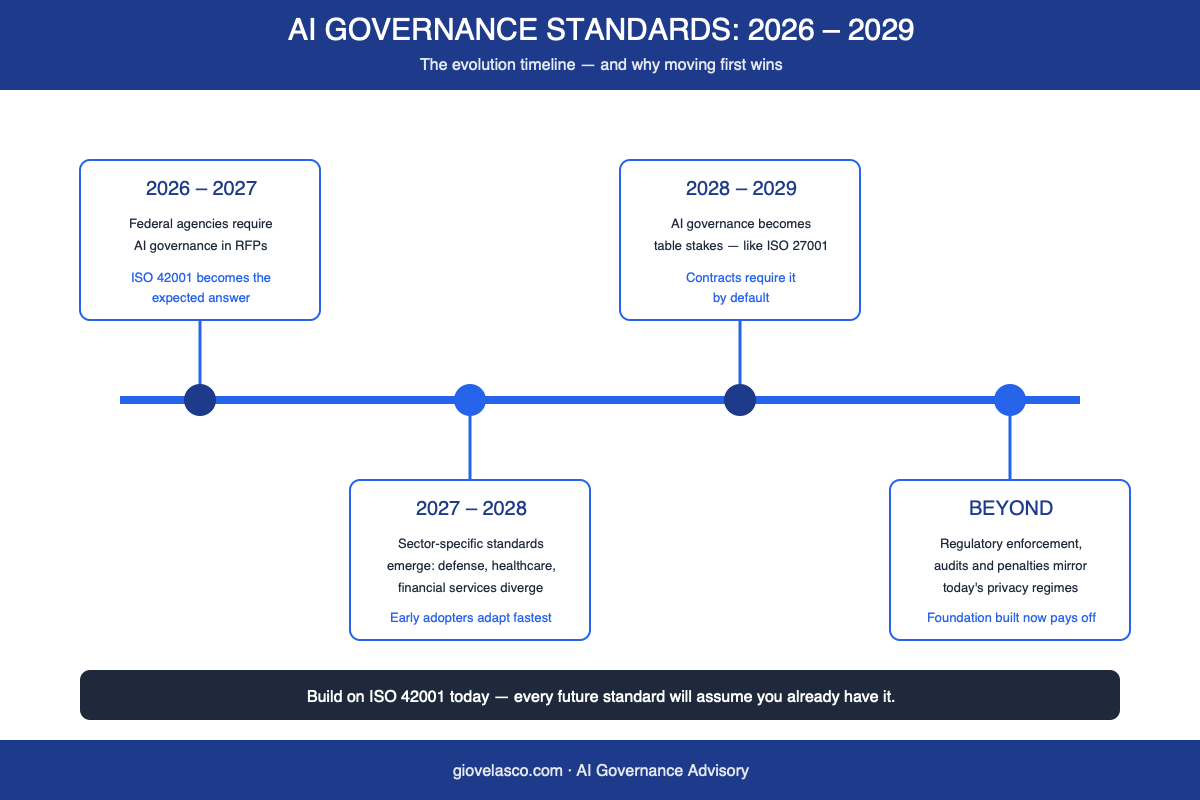
The Timeline: Three Waves Through 2029
2026–2027: governance enters procurement. This wave is already here. Federal agencies are writing AI governance requirements into RFPs, and primes are flowing the questions down their supply chains. ISO 42001 is becoming the expected answer for the simple reason that it’s the only certifiable, auditable AI management standard available. Contractors who can point to a working framework win these questions by default; everyone else writes essays.
2027–2028: sector-specific standards emerge. Generic AI governance splits along industry risk lines, the same way security standards did — the pattern that gave us HIPAA for health data, PCI DSS for payments, and CMMC for defense. Expect defense-flavored AI requirements addressing CUI in training data and model supply chains; healthcare requirements around clinical decision support; financial requirements extending existing model risk management regimes. The EU’s AI Act, already phasing in with its risk-tiered structure, previews exactly this trajectory: obligations scaled to sector and use-case risk.
2028–2029: governance becomes table stakes. This is where AI governance stops being a differentiator and becomes a default contractual condition — the way ISO 27001 or SOC 2 function today in enterprise sales. Enforcement regimes with audits and penalties follow, mirroring today’s privacy landscape. By this wave, “we’re working on it” stops being an acceptable answer in any serious procurement.
Why Early Movers Win Every Subsequent Wave
Here’s the structural insight that makes the timing argument more than consultant urgency: future AI standards will be built on the same skeleton. Every serious governance framework — sector-specific or general, regulatory or contractual — requires an inventory of AI systems, risk assessment against defined criteria, documented accountability, transparency mechanisms, and ongoing monitoring. Those five elements are precisely what ISO 42001 makes you build. When a defense-specific standard lands in 2028, an organization with a living ISO 42001 foundation maps its existing machinery to the new requirements and closes the delta. An organization starting cold builds all five elements under deadline pressure, at premium cost, while competitors are already certified.
We’ve run this experiment before. When CMMC formalized, contractors with genuine ISO 27001 or NIST 800-171 programs adapted in months; contractors starting from nothing needed years, and some are still not ready with the deadline months away. The lesson transfers exactly — I wrote about that adaptation gap in ISO 27001 to CMMC: closing the evidence gap, and the AI version of that article will be written about 2028’s laggards.
Building for AI Governance Standards Future Requirements
Adaptability is a design choice. Four principles keep your foundation portable across whatever the next standard demands:
- Anchor on risk, not on any single standard’s checklist. Risk-driven programs re-map to new frameworks naturally; checklist programs have to be rebuilt. This is the approach from my risk-driven implementation guide, and portability is one of its quiet payoffs.
- Keep the inventory alive. Every future standard starts by asking what AI you run. A quarterly-refreshed inventory with data flows answers the first chapter of every regulation not yet written.
- Document decisions, not just outcomes. Why you accepted a risk, why a model kept a human checkpoint — decision records transfer across frameworks; bare artifacts often don’t.
- Integrate with your security program. Sector-specific AI standards will arrive through the same contractual channels as your security requirements, and shared machinery — one risk process, one incident pipeline, one audit calendar — absorbs new obligations without new bureaucracy.
What This Means for Defense Contractors Specifically
If you’re in the DoD supply chain, the convergence is stark: your CMMC deadline and the first AI governance wave are landing in the same contracts. Federal RFPs requiring AI governance in 2026–2027 will be the same RFPs requiring Level 2 certification. Building both programs on one spine now — the strategy I detailed in CMMC and ISO 42001: a complementary compliance strategy — means the 2028 defense-specific AI wave finds you with the skeleton already standing. Start building ISO 42001 readiness now and you’ll be ahead of 95% of your competitors when the sector standards arrive.
The Future of Compliance Is AI Governance
Every compliance regime follows the same arc: voluntary framework, procurement expectation, sector standards, mandatory enforcement. AI governance is moving through that arc faster than any predecessor because the technology is moving faster. The practical takeaway isn’t to predict every requirement — nobody can. It’s to hold the position from which every requirement is a mapping exercise instead of a rebuild: a living inventory, a risk register your leadership actually argues about, documented accountability, and monitoring that catches problems before customers do.
The companies that move first on AI governance will adapt fastest to whatever comes after ISO 42001 — and they’ll spend less doing it. If you want to build that adaptable foundation while it’s still a competitive advantage rather than a scramble, schedule a discovery call. The best time to start was before the RFPs changed. The second-best time is this quarter.