
CMMC penetration testing security readiness is one of the most misunderstood topics in assessment preparation. Here’s a question I get asked in almost every readiness engagement: “Is CMMC going to involve penetration testing?” Short answer: yes — indirectly. CMMC doesn’t mandate external pentesters, but it does require that you test your controls and act on the results. The distinction matters enormously for your budget and your timeline, because most Tier 2 and Tier 3 contractors either overspend on a formal pentest they don’t need yet or skip testing entirely and walk into their assessment blind. This article explains what’s actually required and how to scope testing that serves your assessment.
What the Framework Actually Asks For
Read the security assessment practices in NIST SP 800-171 carefully and you’ll find requirements to periodically assess your security controls, monitor them on an ongoing basis, and remediate deficiencies. Nowhere does it say “hire a red team.” What it says, in effect, is: prove your controls work by testing them, and prove you fix what the testing finds.
That’s a meaningfully different — and cheaper — obligation than a formal penetration test. A commercial pentest simulates a determined adversary and typically runs $20K–$50K for a defense-relevant scope. A readiness test simulates a C3PAO assessor: can restricted data be reached from an unauthorized account? Can a standard user escalate privileges? Can authentication be bypassed? The goal isn’t to survive a nation-state attack. It’s to show that your controls detect and respond to the attack techniques an assessor will probe — and to generate the documented evidence trail that proves it.
The Four-Phase CMMC Penetration Testing Security Readiness Roadmap
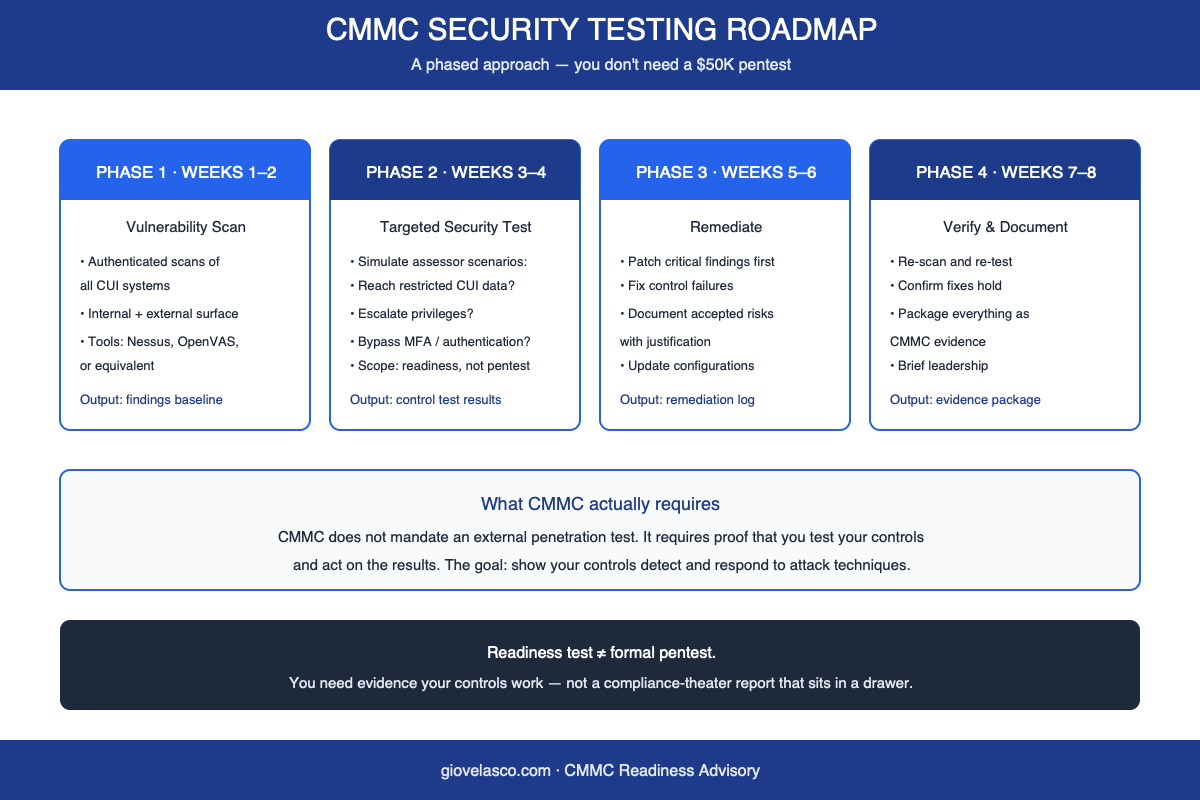
Here’s the phased approach I run with contractors, sized for an eight-week window and an internal-team-plus-advisor budget rather than a red-team budget:
- Weeks 1–2 — vulnerability scan. Authenticated scans across the full CUI boundary, internal and external. This establishes the findings baseline and satisfies the identification half of the requirement. If you already run the monthly cycle I described in my vulnerability management article, this phase is already done.
- Weeks 3–4 — targeted security test. Attempt the assessor scenarios deliberately: reach CUI from an account that shouldn’t have it, escalate from a standard user, bypass MFA, move between network segments that should be isolated. Document every attempt — including the failures, because a blocked-and-logged attempt is exactly the evidence you want.
- Weeks 5–6 — remediate. Fix what the testing found, criticals first. Document accepted risks formally: justification, compensating controls, approval, expiry.
- Weeks 7–8 — verify and package. Re-test to confirm fixes hold, then assemble the whole arc — scan, test, remediation, verification — into your evidence library, indexed to the security assessment practices.
Scoping: Test What the Assessor Will Test
The scoping principle is simple: your test scope is your CUI boundary, and your test scenarios are control-verification questions, not open-ended adversary emulation. Concretely, that means testing the controls that carry the most assessment weight — access restrictions, authentication, session controls, network segmentation between CUI and non-CUI zones, and logging. For each scenario, the deliverable is a short record: what was attempted, from where, what happened, what the logs captured. If the attempt succeeded where it shouldn’t have, that’s a remediation ticket. If it failed and the logs show it, that’s assessment gold.
Techniques don’t need to be exotic. The MITRE ATT&CK framework is a useful menu — pick the handful of techniques relevant to your environment (credential access, privilege escalation, lateral movement) and test your detection of those specifically. An internal IT team with a methodical checklist covers this scope credibly; where I add value as an outside advisor is usually scenario design and knowing which gaps assessors actually pursue.
When a Formal Pentest Is Worth the Money
None of this means commercial penetration tests are useless — it means they answer a different question. Buy one when a contract explicitly requires it, when your prime’s flow-down demands third-party testing, when you’ve passed your CMMC assessment and want genuine adversarial validation, or when your environment includes high-value internet-facing surfaces. Skip it, for now, if the honest purpose would be CMMC preparation — the readiness test above produces more assessment-relevant evidence at a fraction of the cost. You don’t need a $50K pentest. You need evidence that your controls work.
One caution from the field: if you do commission a pentest, budget for the remediation before you budget for the test. A pentest report with unremediated criticals sitting in a drawer is discoverable evidence that you knew about deficiencies and didn’t act — the worst possible artifact to hand an assessor.
Testing Is a Cycle, Not an Event
Like every CMMC domain, security testing proves operating effectiveness through recurrence. One documented test cycle before your assessment is good; a bi-annual rhythm with visible remediation between cycles is what a mature program looks like — and it’s what keeps the next assessment, three years out, from becoming another sprint. Calendar the second cycle before the first one ends.
If you’re unsure whether your controls would survive the assessor scenarios — or you want help designing a readiness test scoped to your actual boundary — schedule a discovery call. We’ll design the test plan in one session, and you’ll know your gaps weeks before anyone else does.