

The deal was progressing well. Strong product demo. Engaged champion. Executive sponsor aligned. Then it went quiet. If that sequence is familiar, there is a good chance the deal didn’t stall because of the product or the pricing — it stalled at SaaS procurement security compliance, specifically during the vendor security review stage. This is one of the most common and least discussed revenue problems in B2B SaaS. Understanding why it happens and what you can do about it before your next big deal reaches that stage is the subject of this post. For a real-world example of the cost, see our case study on how missing SOC 2 cost a SaaS startup $100K.
What Happens During the SaaS Procurement Security Compliance Review
When an enterprise company considers adding a new software vendor, the process typically involves three stages: commercial evaluation (demo, pricing, fit), legal review (contract terms, data processing agreements), and security review (vendor risk assessment, security questionnaire, documentation audit). Most SaaS sales teams are well-prepared for the first two stages. The third is where deals break down.
The security review is conducted by a different team than the champion who was evaluating your product. The security team’s job is not to say yes — it is to identify risk. Their decision-making framework is built around documented evidence, not relationship quality or product enthusiasm. If you cannot produce the documentation they need, they issue a finding. Multiple findings result in a remediation hold. In competitive situations, a remediation hold is often effectively a loss. This is how SaaS procurement security compliance deals get decided — not on product merit.
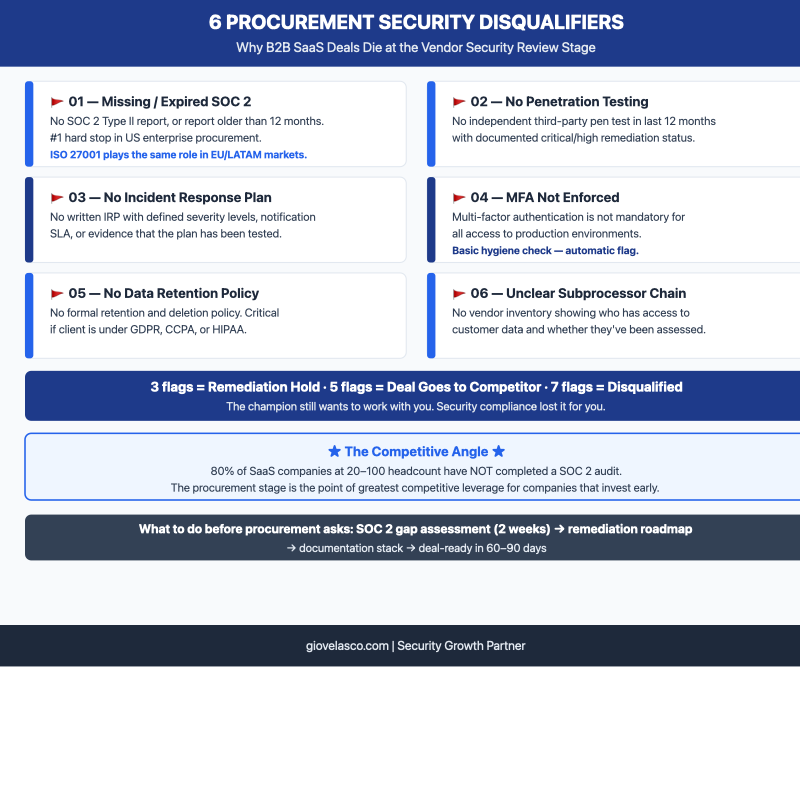
The Six Most Common SaaS Procurement Security Disqualifiers
- Missing or expired security certification. A SOC 2 Type II report older than 12 months, or no report at all, is the single most common hard stop in US enterprise procurement.
- No formal penetration testing from the past 12 months. Enterprise clients need independent validation that your infrastructure has been tested by someone other than your own team.
- Absent or undocumented incident response process. Procurement teams need to know exactly what happens — and how quickly — if there is a security event affecting customer data.
- MFA not enforced across production access. This is a basic hygiene check. If MFA is not mandatory for all access to production environments, it is an automatic flag.
- No formal data retention and deletion policy. Especially relevant if the enterprise client is subject to GDPR, CCPA, or HIPAA.
- Unclear subprocessor and third-party vendor chain. Enterprise clients need to understand who else has access to their data through your platform — and whether those third parties have been assessed.
The Champion Problem in SaaS Procurement Security Deals
One of the most frustrating scenarios is the champion problem — where the internal sponsor genuinely wants to move forward, but cannot override the security team’s concerns. The champion has limited authority over vendor security requirements, which are typically set by the CISO or VP of IT with organizational-level policies that cannot be negotiated away on a deal-by-deal basis.
The way to protect your champion is to enter procurement with a clean security posture. According to CISA’s vendor risk management guidance, a documented security program — not just individual controls — is what enterprise security teams evaluate. When they go to bat for you, the documentation should back them up.
Compliance as Competitive Advantage in SaaS Procurement Deals
The majority of SaaS companies at the 20 to 100 headcount stage have not completed a SOC 2 audit. That means the SaaS procurement security compliance stage — the stage that most SaaS companies dread — is actually the point of greatest competitive leverage for the companies that have invested in compliance ahead of time. When your SOC 2 report, pen test results, and security documentation package land in a procurement team’s inbox within 48 hours of the questionnaire being issued, you have already won the due diligence phase.
What to Do Before Your Next Deal Reaches Procurement
- Less than 30 days out: Documentation triage — identify the gaps most likely to generate flags and create credible interim responses with concrete remediation timelines. A formal gap assessment can be completed in two weeks.
- 60 to 90 days out: Build the complete documentation stack — security overview, vendor FAQ, evidence package, and a gap assessment that demonstrates active progress toward SOC 2. This posture will survive most procurement reviews.
- Building your pipeline now: Start the SOC 2 readiness program immediately. The observation period for a Type II report requires six to twelve months from when your controls are stable. To avoid extending that timeline, read our guide on mistakes that delay SOC 2 certification.
Is your next big deal 90 days out? That’s enough time to build the documentation posture that keeps it alive at procurement. Learn how at giovelasco.com/services.