
Every SOC 2 compliance startup faces the same hidden risk: a deal that progresses through demos, negotiations, and executive alignment — and then dies quietly at procurement because of one missing document. In B2B SaaS, enterprise deals don’t fail because of the product. They fail because of what happens after the demo. This is a case study of exactly that scenario: a $100K deal, a 47-question vendor security questionnaire, and the steps any SaaS company can take to make sure it never happens to them.
What Happened: A $100K Deal That Should Have Closed
The startup had everything working in their favor. Their platform addressed a real pain point for enterprise HR teams. The champion on the client side was vocal about wanting to move forward. The commercial terms were agreed in principle. A kickoff date was being discussed internally on the client side.
Then the procurement team got involved. Enterprise procurement at organizations of any meaningful size follows a structured vendor due diligence process. Security is not an afterthought — it is a primary filter. The vendor security questionnaire arrived with 47 questions. The startup could not answer 31 of them. The deal went on hold. It did not come back.
Why SOC 2 Is a Hard Procurement Gate for Any SaaS Startup
SOC 2 is an auditing standard developed by the American Institute of Certified Public Accountants (AICPA). It evaluates how a service organization handles customer data across five Trust Services Criteria: security, availability, processing integrity, confidentiality, and privacy.
Enterprise procurement teams use SOC 2 Type II reports as a primary proxy for vendor security maturity. A Type II report documents not just the controls you have in place, but whether those controls operated effectively over a period of time — typically 6 to 12 months. For a SOC 2 compliance startup, this distinction matters: you need to start your observation period months before you expect to be closing enterprise deals.
When procurement asks for a SOC 2 report and you don’t have one, one of three things happens: the deal stalls while you scramble to provide alternative documentation, the deal is routed to a competitor that has the report, or your organization is placed on a vendor remediation watchlist. None of those outcomes are acceptable when you have genuine product-market fit and a willing buyer.
The Real Cost of Delayed SOC 2 Compliance for a Startup
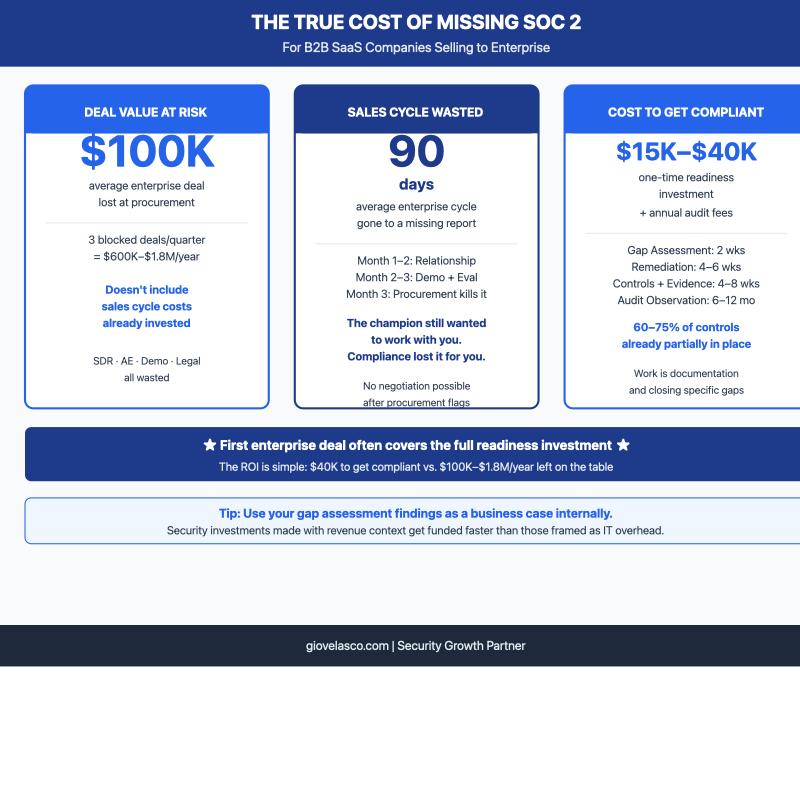
The $100K deal is the headline number. But the actual cost is higher when you account for the pipeline math. Consider a typical B2B SaaS company with an average contract value of $50K to $150K. If three enterprise deals per quarter stall or close at a competitor due to missing SOC 2 compliance, the annual revenue impact is between $600K and $1.8M — not counting the sales cycle costs already invested in SDR hours, AE time, demo resources, legal review, and executive sponsor engagement.
The cost of getting SOC 2 ready is a one-time investment in the range of $15K to $40K depending on your current security posture, plus annual audit fees. The return is often realized on the first enterprise deal it enables.
What SOC 2 Compliance Readiness Actually Looks Like for a Startup
Many SaaS founders assume SOC 2 certification requires a massive security overhaul. In most cases, it doesn’t. What it requires is structure — formalizing the controls you likely already have in place, closing the gaps that matter most, and preparing your documentation for an auditor’s review.
A standard readiness program follows this sequence: gap assessment (2 weeks), remediation planning and policy documentation (4 to 6 weeks), control implementation and evidence collection (4 to 8 weeks), and auditor engagement resulting in a Type II report over a 6-to-12-month observation period. You can learn more about the common mistakes that extend this timeline in our post on mistakes that delay SOC 2 certification.
For most SaaS companies with 20 to 100 employees, the gap assessment reveals that 60 to 75 percent of the required controls are already partially in place. The work is in documentation, consistency, and closing specific technical gaps — not rebuilding your security program from scratch.
How to Present Security Compliance to Enterprise Buyers
Once you have your SOC 2 Type II report, the way you use it matters. Do not make prospects ask for it. Include it proactively in your sales process — attach it to your proposal package, reference it in your security one-pager, and have it ready to send within 24 hours of any security questionnaire request. For more on how enterprise clients evaluate vendor security, see our guide to the 5 security questions enterprise clients ask every SaaS vendor.
Enterprise procurement teams move faster when the vendor has clearly done the work. A clean SOC 2 report, combined with a brief security overview document, removes the need for extensive back-and-forth. It signals organizational maturity — and for a SOC 2 compliance startup, that signal alone has shortened deal cycles by two to four weeks.
Action Steps: What to Do This Quarter
- Run a passive security posture assessment on your own infrastructure to surface issues most likely to appear on a questionnaire.
- Conduct a formal SOC 2 gap assessment with a practitioner who has direct experience fielding enterprise vendor audits. The output should be a prioritized remediation roadmap with specific timeline estimates.
- Use the remediation roadmap to make a business case internally — security investment decisions made with revenue context get funded.
- Engage an auditor early, before you think you’re ready. Auditor availability is a common bottleneck and the observation period needs to start as soon as controls are stable.
Need a SOC 2 gap assessment? I help B2B SaaS companies get audit-ready without slowing down product development. Full gap assessment in two weeks. Learn more at giovelasco.com/services.