
An ISO 42001 implementation risk-driven approach fixes the mistake I see in almost every AI governance project: organizations start with compliance. “We need to check all the boxes.” That’s backward — and it produces the worst outcome in compliance work, which is a complete-looking program that governs nothing. Before you build an AI governance framework, ask three questions: Where are we using AI? What could go wrong? How do we prevent that? Answer those first and ISO 42001 assembles itself around real problems. This article gives you the working method, including the workshop agenda I run with clients and the prioritization matrix that turns findings into a roadmap.
Why Checklist-First Implementations Fail
The ISO 42001 standard is a management system standard, which means it’s deliberately generic — it tells you to assess risks, implement controls, and monitor performance, but not which risks or which controls, because those depend on your business. Checklist-first implementations skip that dependency. They copy a template AI policy, generate the required document set, and declare readiness.
Then reality arrives. The template policy prohibits things the business depends on, so people ignore it. The risk register lists generic risks (“AI may produce biased output”) with no connection to actual systems, so nobody monitors anything specific. Twelve months later the program exists on paper and nowhere else — and if you eventually pursue certification, an auditor spots the gap in the first interview. That’s not bureaucracy failing; that’s bureaucracy without a purpose. The organizations I work with that built effective AI governance were solving real business problems: model bias was costing them customer trust, transparency was contractually required by customers, performance drift was creating operational risk. ISO 42001 gave them a framework to address those problems systematically. Start with risk. Compliance follows.
The Risk Workshop: A Half-Day That Anchors Everything
Every risk-driven implementation I run starts with a structured half-day workshop. Here’s the agenda, usable as-is:
- Hour 1 — AI inventory. Every department lists every tool with an AI capability: sanctioned projects, embedded vendor features, and the shadow tools people actually use. Record what data feeds each one. Expect the list to be two to three times longer than leadership predicted.
- Hour 2 — failure storytelling. For each significant AI use, ask one question: “Tell me the story of this going wrong.” Concrete narratives — the forecast model that quietly drifted and overcommitted a production line, the résumé screener that filtered out a protected group — surface risks that abstract categories miss.
- Hour 3 — scoring. Place each risk on a likelihood-versus-impact grid. Argue about placements out loud; the arguments are where the organization actually learns its own risk posture.
- Hour 4 — ownership. Every risk in the top-right of the grid gets a named owner and a 90-day action. No unowned risks leave the room.
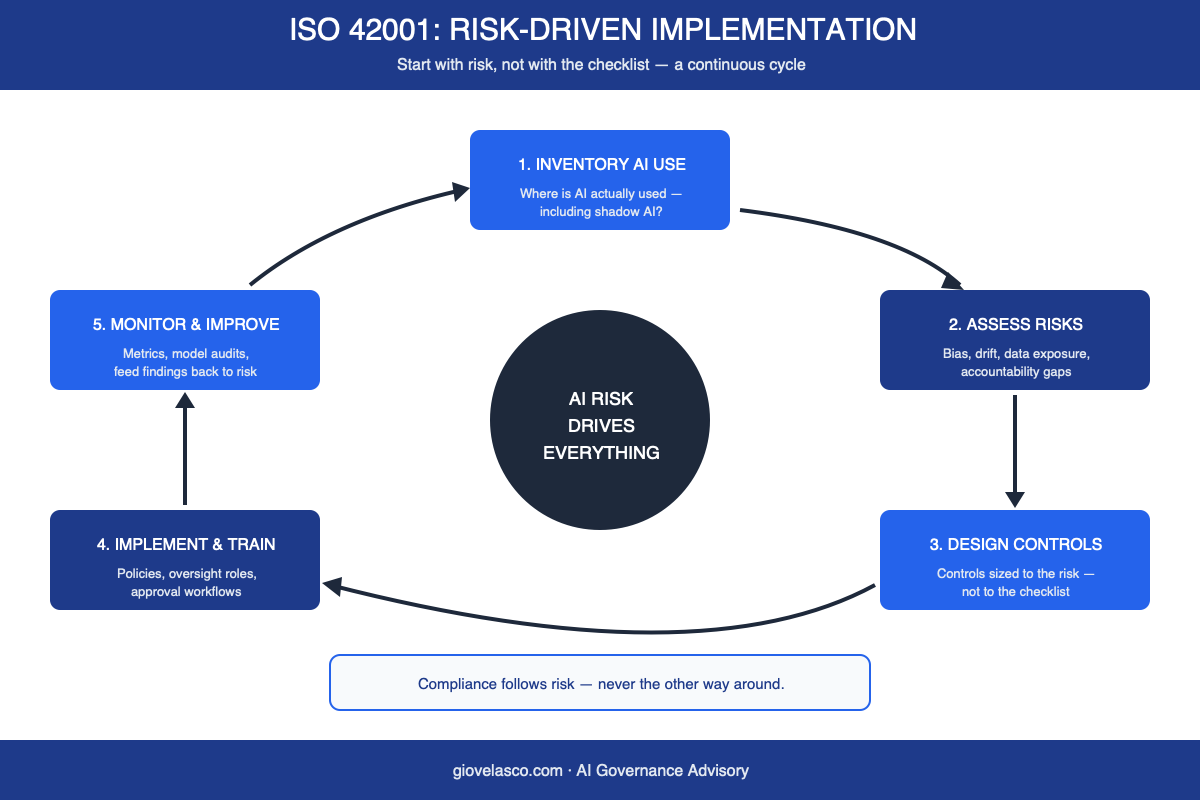
From Risk Register to ISO 42001 Implementation Roadmap
The workshop output — an inventory, a scored risk register, and owned actions — converts into an implementation sequence with a simple rule: controls get built in risk order, and every control cites the risk that justifies it.
In practice, the top-right quadrant almost always drives the same first wave: a data boundary rule (what may never enter which AI tools — for defense contractors, CUI tops that list), human review requirements for consequential decisions, and monitoring with thresholds for production models. The second wave builds the management system around those controls: the AI policy that codifies what the first wave already does, role definitions, training, and the documentation ISO 42001 expects. The third wave is the improvement loop — periodic model audits, drift reviews, and a quarterly risk register refresh that feeds new findings back to the top of the cycle.
Notice the inversion from checklist-first: the policy documents what’s already operating, instead of demanding things nobody does. When certification auditors eventually arrive, that inversion is visible and it works enormously in your favor — auditors can always tell a program that was lived-in from one that was generated.
Prioritization When Resources Are Thin
Most mid-size organizations can’t fund a dedicated AI governance function, and the risk-driven method is specifically designed for that constraint. The grid does the budgeting for you: act-now risks get real money and named owners this quarter; control-tier risks get monitoring and a scheduled review; monitor-tier items get a watchlist; accept-tier items get a documented acceptance and zero further spend. Governance that can’t consciously accept a small risk isn’t governance — it’s anxiety with paperwork.
For defense contractors, one more sequencing note: run this alongside your CMMC program, not after it. The workshop’s data-boundary findings feed your CUI protection work directly, and roughly 40% of the management machinery is shared between the two frameworks — the integration case I laid out in CMMC and ISO 42001: a complementary compliance strategy.
What Working Governance Looks Like a Year In
Twelve months into a risk-driven implementation, the program is small and visibly alive: an inventory that gets updated when new tools appear, a risk register the leadership team argues about quarterly, a handful of monitored models with thresholds someone actually watches, and an audit trail of caught-and-corrected issues. That last artifact — problems found by your own monitoring, fixed, and documented — is the single strongest evidence of a functioning management system, for auditors and customers alike.
That’s what an ISO 42001 implementation risk-driven approach buys you: a program sized to your actual risks, adopted because it solves named problems, and certifiable when the market demands it. If you want to run the risk workshop with someone who’s facilitated it across manufacturing and defense environments, schedule a discovery call — half a day with your leadership team, and you’ll leave with the register and the roadmap.