
CMMC incident response documentation evidence is where I see the widest gap between what contractors think they have and what assessors actually accept. Here’s what I see most often in readiness engagements: the company has a good incident response plan. Professionally written, sensible escalation paths, clear roles. What they don’t have is incident response evidence — and those are entirely different things. A plan describes what you would do. Evidence proves what you did. C3PAO assessors are paid to care about the second one — and with third-party assessments paused since July 2026, so are the primes reviewing the self-assessment behind your SPRS score. This article explains how to produce that evidence even if you’ve never had a real security incident.
The Plan-Versus-Proof Problem
The incident response requirements in NIST SP 800-171 look deceptively light — a handful of practices covering detection, reporting, response, and testing. Contractors read them, point at their IR plan binder, and move on to harder domains. That’s the mistake.
When the assessment arrives, the assessor’s questions are operational: Show me your incident reports from the last year. Walk me through how this investigation was documented. Who was notified, when, and where’s the record? What did you change afterward? A binder full of procedures answers none of those questions. Most contractors I work with have incident templates. Few have incident documentation from real events — because, thankfully, most haven’t had serious incidents. The framework anticipates this, and so should you.
What CMMC Incident Response Documentation Evidence Looks Like
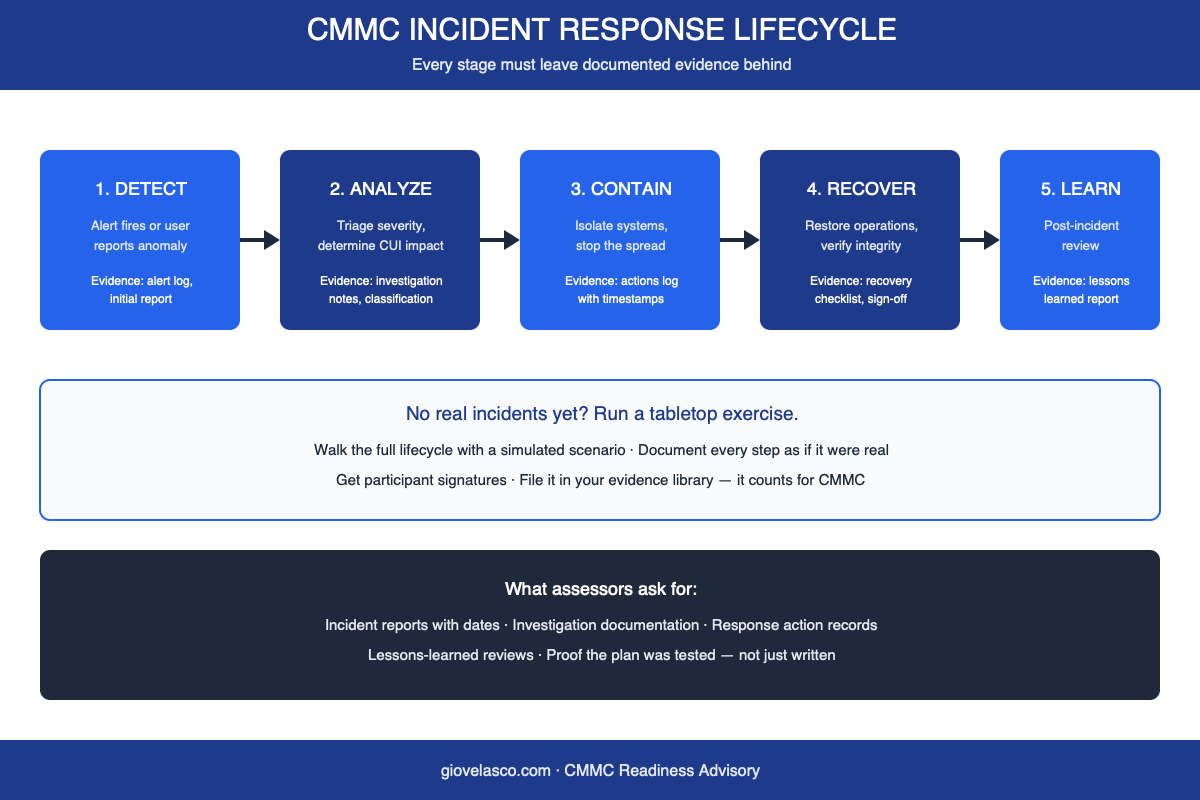
Concretely, the artifact set assessors expect covers the full lifecycle of an event:
- Incident reports — dated records of what was detected, how it was classified, and who took ownership.
- Investigation documentation — the notes, timelines, and findings showing the event was actually analyzed, including whether CUI was affected.
- Response action records — timestamped containment and recovery steps: which systems were isolated, what was restored, who signed off that operations resumed safely.
- Lessons learned — the post-incident review, with the changes it produced. This is the artifact that proves the process improves itself, and it’s the one most often missing.
Notice what’s common across all four: dates, names, and signatures. Evidence without attribution is anecdote. The discipline is identical to what I described for access control evidence — the control is the documented cycle, not the document about the cycle.
The Tabletop Exercise: Your Fastest Path to Real Evidence
If you haven’t had a security incident, you don’t need to wait for one — and you certainly shouldn’t hope for one. Conduct a tabletop exercise, walk through your response process against a realistic scenario, document it like it was real, and get signatures. That exercise counts as evidence for CMMC purposes. It demonstrates your process works, your people know their roles, and your documentation machinery functions under (simulated) pressure.
Here’s how I run these with clients, in about three hours total. Pick a scenario with teeth: a phishing email harvested a CUI user’s credentials, or ransomware appeared on a workstation with access to contract data. Assemble the actual response team — not just IT, but whoever handles communications, legal exposure, and prime contractor notification. Walk the scenario in real time: detection, classification, containment decisions, recovery steps, notification triggers. One person’s only job is documentation: timestamps, decisions, who did what. Afterward, hold the lessons-learned review while memories are fresh, write up the gaps you found, and have participants sign the record.
The write-up should look exactly like a real incident report — because structurally it is one. Scenario summary, timeline, actions taken, gaps identified, corrective actions with owners and due dates. File it in your evidence library indexed to the IR practices, and calendar the next exercise. Two documented tabletops a year, each producing corrective actions that visibly got done, is a stronger evidence position than many contractors with real incidents can show — because real incidents are often documented badly, in a panic, after the fact.
Don’t Forget the Reporting Obligations
For defense contractors, incident response doesn’t end at your network boundary. DFARS 252.204-7012 requires reporting cyber incidents affecting covered defense information to the DoD within 72 hours through the DIBNet portal. Your IR plan needs that trigger built in explicitly: who determines whether an event is reportable, who files, and what the 72-hour clock means for your escalation timing. Assessors ask about this, and “we’d figure it out” is a finding. Your tabletop scenario should exercise the reporting decision even if the simulated answer is “not reportable” — the documented decision process is the evidence.
Building the Habit in 60 Days
If your assessment is on the horizon, here’s the practical sequence. Weeks 1–2: pressure-test the plan itself — confirm roles map to real people who still work for you, and add the DFARS reporting trigger if it’s missing. Weeks 3–4: run the tabletop and produce the full documentation package. Weeks 5–6: execute the corrective actions the exercise surfaced, with dated closure records. Weeks 7–8: brief leadership, update the plan with what you learned, and schedule the next exercise so the cycle is visibly recurring. Total investment: perhaps two working days spread across two months. That’s the entire cost of converting your IR domain from a paper plan into assessable proof.
Incident response without documentation is just a good intention. Documentation turns it into proof — and proof is the currency your assessment trades in. If you’d like a second set of eyes on your IR evidence before an assessor sees it, or help designing a tabletop that actually stresses your process, schedule a discovery call — I’ll bring the scenario.