
If you sell to enterprise clients, the enterprise security questionnaire for SaaS vendors is not an optional part of your sales process — it is a stage that every deal must pass through before contracts are signed. Understanding exactly what procurement teams are looking for, and preparing precise well-documented answers, is one of the highest-leverage investments a B2B SaaS company can make to accelerate deal cycles. This post covers the five questions that appear on virtually every enterprise security questionnaire for SaaS companies, what procurement teams are actually evaluating, and how to prepare answers that move deals forward. To understand the real business cost of not being prepared, read our case study on how missing SOC 2 cost a SaaS startup $100K.
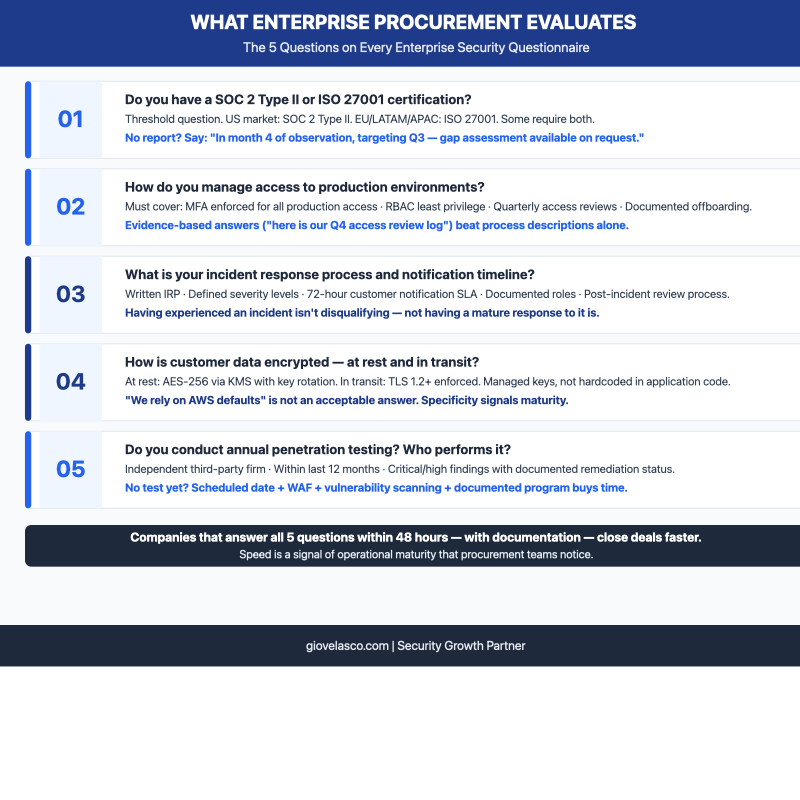
The five questions that appear on virtually every enterprise security questionnaire for SaaS vendors:
- Do you have a current SOC 2 Type II or ISO 27001 certification?
- How do you manage access to production environments?
- What is your incident response process and notification timeline?
- How is customer data encrypted — at rest and in transit?
- Do you conduct annual penetration testing? Who performs it?
Question 1: SOC 2 or ISO 27001 — the Threshold of Every Enterprise Security Questionnaire for SaaS
This is the threshold question. SOC 2 Type II is the dominant standard for US-based enterprise procurement, governed by the AICPA’s Trust Services Criteria. ISO 27001 is required or strongly preferred in EU, LATAM, and APAC markets. Some enterprise clients in financial services and healthcare will require both.
If you have a current report, attach it immediately. If you don’t, your answer needs to acknowledge the gap and demonstrate credible progress with a concrete timeline. “We are currently in the 60-day observation period for SOC 2 Type II, targeting completion in Q3” is a response that keeps the deal alive. “We are working on it” is not.
Question 2: How Do You Manage Access to Production Environments?
This question evaluates identity and access management maturity. The correct answer covers four elements: multi-factor authentication enforced for all production access, role-based access control with least-privilege principles, access reviews conducted on a defined cadence (quarterly is standard), and a documented offboarding process that includes immediate revocation of access.
Evidence-based answers — “here is our access review log from last quarter” — are significantly stronger than process descriptions alone. For every item on an enterprise security questionnaire for SaaS teams, specificity signals maturity.
Question 3: What Is Your Incident Response Process and Notification Timeline?
The baseline answer includes a written incident response plan with defined severity levels, a 72-hour notification timeline for customer-impacting events (aligned with GDPR and most enterprise SLAs), defined roles and responsibilities during an incident, and a post-incident review process.
If you have experienced an incident, be transparent. Enterprise procurement teams are not disqualifying vendors for having experienced security events — they are disqualifying vendors who cannot demonstrate a mature response to them.
Question 4: How Is Customer Data Encrypted — At Rest and In Transit?
Data in transit should be encrypted using TLS 1.2 or higher. Data at rest should be encrypted using AES-256 or equivalent. Encryption keys should be managed using a dedicated key management service, not hardcoded in application code. “We rely on AWS defaults” is not an acceptable answer. Specificity — “AES-256 via AWS KMS with 90-day key rotation, TLS 1.3 enforced via API gateway” — is the answer that moves the deal forward. On an enterprise security questionnaire for SaaS vendors, every question is an opportunity to signal maturity.
Question 5: Do You Conduct Annual Penetration Testing? Who Performs It?
Enterprise procurement teams want independent validation that your infrastructure has been formally stress-tested. The key word is independent. What they want to see: a formal penetration test conducted by a recognized third-party firm within the last 12 months, with a summary of findings and a documented remediation status for critical and high-severity items.
If you do not yet have a current penetration test, the compensating answer is a scheduled test with a confirmed date, combined with evidence of automated vulnerability scanning, a WAF in place, and a documented security program that demonstrates operational maturity.
Building a Documentation Package That Answers Every Enterprise Security Questionnaire for SaaS Deals
The most efficient way to handle enterprise security questionnaires is to build a reusable security documentation package — a curated set of documents that can be sent to procurement teams at any stage of the deal cycle. At a minimum, that package should include a current SOC 2 or ISO 27001 report (or a gap assessment with a certification timeline), a one-page security overview, a vendor security FAQ covering the top 25 to 30 most common questionnaire items, and your penetration testing executive summary with finding remediation status.
For a step-by-step guide to building this system, see our post on how to answer enterprise security questionnaires without a large team. With the right starting point — a formal gap assessment — most of this content can be drafted and reviewed in two to three weeks.
Want a security documentation package built for your company? I build gap assessments and response libraries specifically designed to answer these five questions — and the 42 others that follow. Learn more at giovelasco.com/services.