
Not every SaaS company has a SOC 2 report when their first significant enterprise deal triggers a vendor security assessment. The gap between when enterprise buyers start requiring security assurance and when a SaaS company is ready to provide it is real — and bridging that gap requires more than apologizing for the absence of a report. A vendor security assessment without SOC 2 is harder to pass, but it is not impossible.
The companies that succeed are those that prepare a structured alternative documentation package that demonstrates security maturity without the third-party attestation that a report provides. This post explains what that package looks like and how to use it effectively. For context on what enterprise procurement teams actually evaluate during vendor reviews, see our post on what enterprise procurement teams look for in vendor security reviews.
Why the Absence of SOC 2 Is Not Automatically Disqualifying
Enterprise security reviewers know that not every vendor has completed a SOC 2 audit — particularly early-stage companies that may be encountering their first significant enterprise deal. What reviewers evaluate is not the presence of a specific credential but the evidence that an organization takes security seriously and has controls in place.
A vendor that responds to a security questionnaire with a comprehensive, well-organized documentation package — current policies, evidence of implemented controls, a credible roadmap to SOC 2 certification — is a more credible vendor than one that has a SOC 2 report but cannot answer follow-up questions about their environment. The certification is valuable because it provides independent assurance. The underlying program is what the certification attests to. In the absence of the certification, demonstrating the program directly is the alternative.
What You Need to Substitute for a SOC 2 Report
Passing a vendor security assessment without SOC 2 requires a specific set of documentation that covers the same control areas a SOC 2 report would address. These five artifacts, well-organized and professionally presented, address the most common vendor security questionnaire categories.
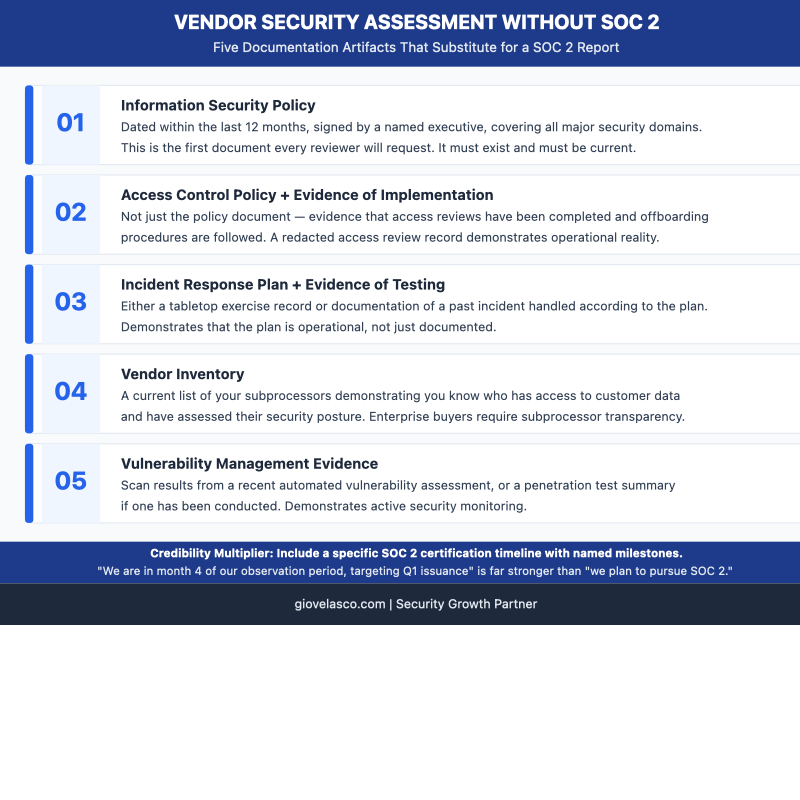
The first artifact is a current Information Security Policy — dated within the last 12 months, signed by a named executive, and covering the major security domains your questionnaire will ask about. The second is an Access Control Policy with evidence of implementation — not just the policy document, but evidence that access reviews have been completed and that offboarding procedures are followed. A summary access review record or a redacted access provisioning log demonstrates operational reality.
The third is an Incident Response Plan with evidence of testing — either a tabletop exercise record or documentation of a past incident that was handled according to the plan. The fourth is your vendor inventory — demonstrating that you know who your subprocessors are and have assessed their security posture. The fifth is evidence of vulnerability management — scan results from a recent automated vulnerability assessment, or a penetration test summary if one has been conducted.
These five artifacts do not replace a SOC 2 report, but they demonstrate a program that is on a credible path to one. Many organizations also reference the CSA CAIQ self-assessment as an additional structured framework for presenting security posture in vendor reviews.
Vendor Security Assessment Without SOC 2: The Credibility of Commitment
One of the most effective elements in a vendor security package without a SOC 2 report is a credible, specific commitment to certification with a realistic timeline. Enterprise buyers understand that SOC 2 Type II takes 12 to 16 months. A company that can say “we are currently in month four of our observation period, targeting an issued report by Q1 of next year” is in a fundamentally different position than one that says “we plan to pursue SOC 2 at some point.”
Specificity signals seriousness. Vague future commitments are discounted. A documented readiness timeline with named milestones — gap assessment complete, policies documented, observation period start date, target audit engagement date, estimated report issuance date — is a credible substitute for the report itself in many mid-market vendor reviews. For guidance on building that readiness timeline, see our post on SOC 2 readiness and the enterprise sales cycle.
How to Present Your Security Package Effectively
The presentation of your security documentation matters as much as its content. A disorganized collection of files emailed in response to a questionnaire reads as an ad hoc program. A professionally structured security package delivered with a clear index and consistent branding reads as a managed program.
Structure your package with a cover page that includes your company name, the date, a contact for security inquiries, and a table of contents. Organize the documentation by the same categories as the questionnaire. Reference specific documents for specific questions rather than submitting a stack of files and leaving the reviewer to find the relevant material.
If you have a vCISO or named security officer, include their name and credentials in the cover page and as the security contact. A CISSP-certified security contact reviewing a questionnaire response signals organizational investment in security that an anonymous submission does not.
What to Do After You Pass the First Assessment
Passing a vendor security assessment without SOC 2 should accelerate your commitment to completing the certification — not validate continuing without it. The energy and documentation investment that goes into building a strong substitute package is largely the same investment required to complete your SOC 2 readiness program. The difference is the audit, the observation period, and the third-party attestation.
Use the questionnaire as a gap assessment tool. The questions you struggle to answer confidently identify the control areas that need development before your audit. The documentation you build for the assessment becomes the foundation of your SOC 2 evidence library. The vendor security assessment without SOC 2 is a bridge strategy — valuable for the deals you need to close right now, but not a long-term alternative to the certification your enterprise pipeline will increasingly require.
Want to know exactly where your documentation stands against enterprise reviewer criteria? Download the free 70-Point Enterprise Security Readiness Assessment at giovelasco.com/guide — and identify exactly what needs to be built before your next assessment.
— Giovanni Velasco · CISSP · Security Growth Partner · giovelasco.com