
SOC 2 evidence collection is the operational core of your audit — and the stage where most companies lose weeks of time, generate unnecessary audit findings, and create friction between their teams and their auditors. Understanding what evidence your auditor will request, how to organize it, and how to build a collection process that is repeatable across audit cycles is the difference between a smooth engagement and a disruptive one.
This post covers the major evidence categories in a SOC 2 audit, the most common collection gaps, and the system for organizing evidence that reduces audit burden year over year. For context on how auditor selection affects what evidence gets requested, see our post on SOC 2 auditor selection.
Why SOC 2 Evidence Collection Breaks Down in Practice
The most common reason SOC 2 evidence collection fails is not a lack of controls — it is a lack of documentation for controls that actually exist. Organizations frequently have access review processes, change management procedures, and incident response activities that are practiced but not recorded in a way an auditor can evaluate.
An auditor cannot accept “we do this consistently” as evidence. They need logs, records, approvals, screenshots, or other artifacts that demonstrate the control operated during the observation period. A quarterly access review that happened but was not documented produces the same audit finding as one that did not happen at all.
The second common failure is fragmented evidence storage. When evidence is scattered across email threads, shared drives, ticketing systems, and individual laptops, the collection process requires significant coordination every time an auditor request arrives. This fragmentation creates delays and creates risk that evidence is missed or inconsistently presented.
What Evidence Your Auditor Will Request
SOC 2 evidence collection covers nine primary categories that map to the AICPA Trust Services Criteria. Understanding each category before your observation period begins allows you to build collection practices proactively rather than reactively.
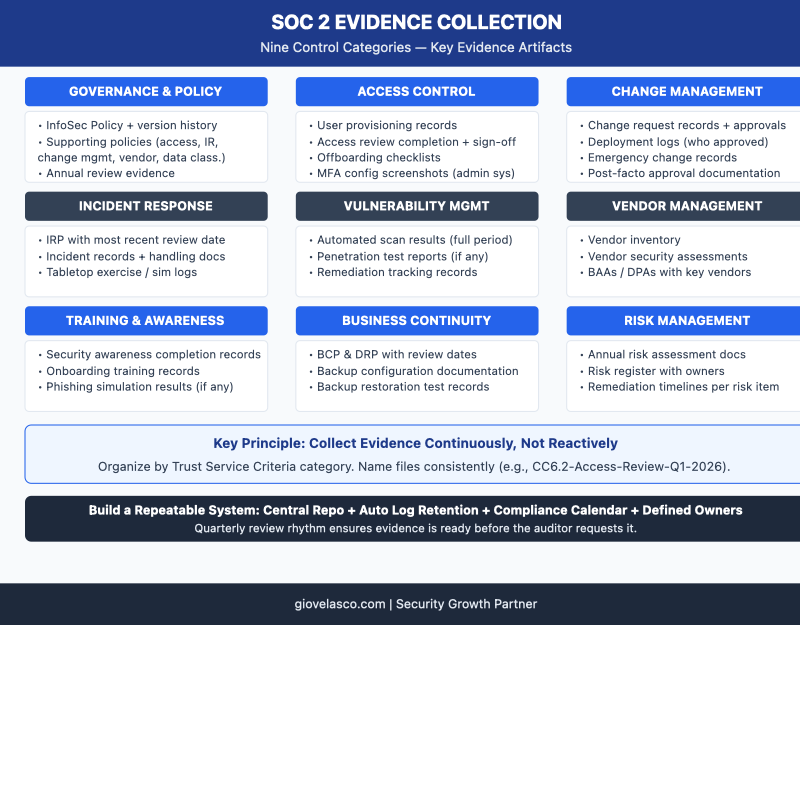
Governance and policy evidence includes your current Information Security Policy, all supporting policies — access control, change management, incident response, vendor management, data classification — with version history and evidence of annual review.
Access control evidence includes user access provisioning records, access review completion records with sign-off documentation, offboarding checklists with system access revocation confirmation, and MFA configuration screenshots for all administrative systems.
Change management evidence includes change request records with approval signatures or system approvals, deployment logs showing who approved and executed each production change, and emergency change records with post-facto approval documentation.
Incident response evidence includes your incident response plan with the most recent review date, records of any security incidents during the observation period with documented handling, and tabletop exercise records or simulation logs. Vulnerability management evidence includes automated scan results from your scanning tool for the observation period, penetration test reports if applicable, and remediation tracking records.
Vendor management evidence includes your vendor inventory, vendor assessment records for critical vendors, and copies of security addenda or data processing agreements with key vendors. Training and awareness evidence includes completion records for security awareness training for all employees, onboarding training records, and any phishing simulation results if conducted.
Business continuity evidence includes your BCP and DRP documents with review dates, backup configuration documentation, and backup restoration test records. Risk management evidence includes your annual risk assessment documentation and your risk register with owner assignments and remediation timelines. Together, these nine categories map to the NIST SP 800-53 control reference framework that underlies the Trust Services Criteria.
SOC 2 Evidence Collection: Building a Repeatable System
The organizations that handle SOC 2 evidence collection most efficiently treat it as an operational activity rather than an audit preparation project. Evidence is collected continuously — logs are retained automatically, access reviews are completed and documented on schedule, training records are captured in real time — rather than assembled reactively when the auditor requests it.
Building this system requires four components: a central evidence repository, automated log retention, a recurring compliance calendar, and a defined evidence owner for each control category. The central repository can be as simple as a shared drive with a consistent folder structure organized by control category. What matters is that every person who generates compliance-relevant evidence knows where to put it and puts it there in real time.
How to Organize Your Evidence Repository
The most effective SOC 2 evidence repository structure mirrors the Trust Service Criteria categories. Create a folder for each category — CC1 through CC9 for the Common Criteria, plus additional folders for any optional criteria in scope — and within each folder, create subfolders for each evidence type.
Label evidence files with consistent naming conventions that include the control reference, the date, and the type of evidence. An access review file labeled “CC6.2-Access-Review-Q1-2026” is findable and contextually clear without opening the document. Files named “screenshot-march” are not.
Establish a quarterly review rhythm for the repository. At the end of each quarter, confirm that all expected evidence artifacts for that quarter have been collected and are in the repository. This rhythm means that when your auditor submits their evidence request list, you are retrieving pre-organized documentation rather than assembling it under deadline pressure.
What to Do When You Have Evidence Gaps
When a gap assessment or pre-audit review reveals that evidence is missing for controls that are being practiced, the path forward is different depending on whether you are in a pre- or post-observation period.
If you are in the pre-observation period — before the 12-month window your Type II audit will cover — the gap is addressable. Implement the documentation practice immediately and build the evidence record from that point forward. A clean 12-month observation period will not be affected by the absence of earlier records.
If you are in the mid-observation period and discover that evidence has not been collected for controls that have been operating, work with your auditor to understand whether compensating evidence — system logs, configuration records, or third-party system records — can support the control claim. Some evidence gaps can be partially addressed with system-generated records even when manual documentation is absent. Others cannot, and will result in findings.
The practical lesson is that pre-audit gap assessments are most valuable when they identify documentation gaps early enough to address them before the observation period begins. The security policies that every SaaS company must have documented are covered in our post on the 7 security policies every SaaS company needs.
Preparing for a SOC 2 audit and want to understand your evidence gaps before your observation period begins? Download the free 70-Point Enterprise Security Readiness Assessment at giovelasco.com/guide — it identifies evidence gaps across all nine control categories before your auditor does.
— Giovanni Velasco · CISSP · Security Growth Partner · giovelasco.com