
Why SOC 2 Compliance Is One of the Fastest Ways to Unlock Enterprise Sales Cycles


The Deal That Almost Didn’t Happen
A software company selling project management tools to mid-market professional services firms had been in conversation with a prospect for four months. The champion loved the product. The pricing was approved. Then the procurement team sent a standard vendor security questionnaire. The connection between SOC 2 compliance and enterprise sales outcomes is one of the least-discussed and most consequential decisions an early-stage SaaS company can make.
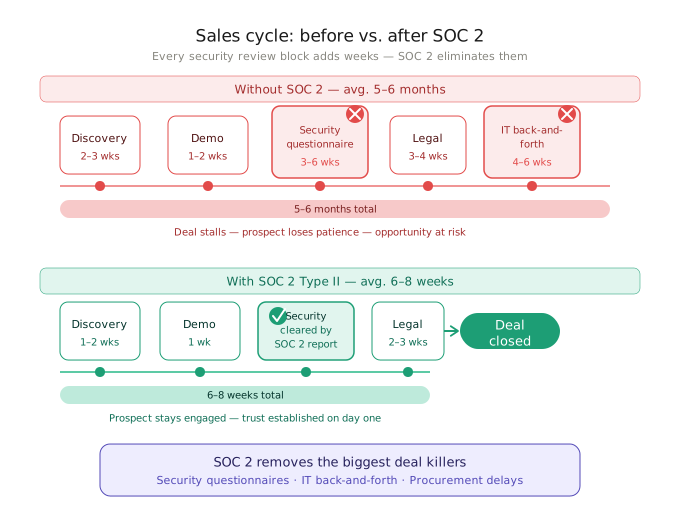
Without a SOC 2 report, the vendor’s team spent three weeks manually answering 140 questions. Two answers required clarification. One triggered a follow-up from the buyer’s IT team. By the time the deal closed, the sales cycle had extended by six weeks, and the internal goodwill had eroded noticeably. The contract was signed — but it very nearly wasn’t.
The cost of not having a SOC 2 report was not a rejected deal in this case. It was six weeks, two rounds of revision, and a relationship that started under unnecessary pressure. Multiply that by every enterprise deal in your pipeline, and the calculus becomes clear.
How SOC 2 Compliance Changes the Enterprise Sales Conversation
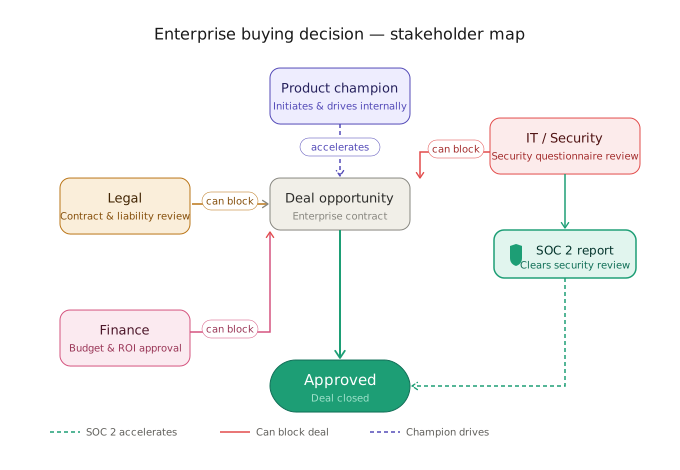
The decision to sign a software contract at an enterprise company involves more stakeholders than most SaaS founders track. The product champion drives the evaluation. Legal reviews the agreement. IT or security reviews the vendor’s risk posture. Finance approves the spend. Each of those parties has the ability to slow or stop the deal.
Security and IT reviewers operate under a different mandate than the product champion. They are not evaluating whether your product solves a problem. They are evaluating whether bringing your product into the organization creates a manageable or unmanageable risk. Their job is to protect the organization, not to buy software.
A SOC 2 Type II report changes their calculus significantly. It is not a perfect signal — it does not guarantee your product has no vulnerabilities — but it provides structured, third-party evidence that your security controls have been independently verified over time. For a security reviewer with 15 vendors to evaluate, that evidence shifts you from ‘needs investigation’ to ‘satisfies baseline requirements.’
The Time Savings Are More Significant Than They Appear
The most visible benefit of having a SOC 2 Type II report in a sales process is the elimination — or dramatic reduction — of vendor security questionnaires.
A standard enterprise vendor security questionnaire runs between 80 and 200 questions. Answering one thoughtfully takes between 10 and 30 hours, depending on how much of your organization’s security posture is documented. If you have a SOC 2 report, you can typically respond to 80 to 90 percent of those questions with a single attachment and a short note referencing the relevant sections.
For a SaaS company in active growth mode, this is not a theoretical efficiency. It is a recoverable time for your sales engineers, your CTO, and anyone else who gets pulled into a security review. It is also a qualitative signal to the buyer: a company that has done the audit work sends those questionnaire responses in 24 hours, not three weeks.
The Competitive Reality. In most mid-market and enterprise vendor evaluations, you are not the only vendor being assessed. Shortlists move at the pace of the slowest reviewer — and the vendor that makes the security review easy wins on process, not just product. A SOC 2 Type II report is how you remove yourself from the ‘pending security review’ column.tion for this block. Use this space for describing your block. Any text will do. Description for this block. You can use this space for describing your block.
The Deal Categories Where Compliance Makes or Breaks the Outcome
Not every enterprise deal is blocked by a missing SOC 2 report. But specific deal profiles almost always require it:
- Any contract involving access to the buyer’s customer or employee data
- Any integration with the buyer’s core business systems (ERP, CRM, financial platforms)
- Any vendor contract above a defined dollar threshold — most enterprise companies have a formal review trigger
- Any deal where the buyer operates in a regulated industry — financial services, healthcare, insurance, government contractors
- Any contract where the buyer itself is selling to enterprises and passes its vendor scrutiny downstream
If your ICP (ideal customer profile) touches any of these categories consistently, treating SOC 2 as optional is a strategic error. You will face this requirement in most deals above a certain size. The question is whether you are ready for it.
How Compliance Functions as a Competitive Differentiator
There is a version of SOC 2 readiness that is purely defensive: you get the report so you can answer the questionnaire. That is the floor. The ceiling is considerably more interesting.
Companies that proactively include their SOC 2 report in proposals — before the buyer asks — shift the frame of the sales conversation. They are not responding to a risk concern. They are leading with evidence of organizational maturity. That distinction registers with sophisticated enterprise buyers.
The positioning is simple: ‘We take security seriously enough to have it independently verified annually. Here is our most recent report.’ That sentence does more work in an enterprise evaluation than three slides of security feature bullets.
The downstream effects compound over time. Renewal conversations are smoother because the security program is consistent and documented. Upsell conversations face less friction because the trust is already established. Customer success relationships operate at a higher level because the buyer knows what your controls are and can speak to them internally.
When to Start
The most common answer to ‘when should we start our SOC 2 program?’ is ‘before the deal you wish you had started before.’ That is not useful guidance. More useful is this: the right time to start is the moment your ICP includes companies with more than 200 employees, operates in a regulated industry, or has any legal obligation to screen its vendors.
At that ICP, the first enterprise deal you lose or delay because of a missing compliance report will cost you more than the entire SOC 2 engagement would have. The math is straightforward. The challenge is that founders typically don’t recognize the pattern until they have already paid the cost two or three times.
Understand Where You Stand Right Now
The 70-Point Enterprise Security Readiness Guide at giovelasco.com/guide gives you a clear-eyed picture of your current security posture against the control areas enterprise buyers evaluate. Download it for free and use it before your next enterprise proposal — not after the procurement team sends the questionnaire.