
The Deal That Seemed Fine Until It Wasn’t
A SaaS founder in the workflow automation space had a pipeline full of solid mid-market opportunities. None of them had explicitly asked about SOC 2. The company was growing at a healthy pace, the product was strong, and security felt like something to address when we get serious enterprise deals.
Then two things happened in the same quarter. A healthcare organization in advanced discussions asked for a SOC 2 Type II report. And a financial services firm requested their standard vendor security questionnaire — 180 questions, with a 10-business-day deadline.
The founder lost the healthcare deal. The security questionnaire took four weeks to answer with the help of two engineers and the legal team. Neither outcome was because the company having poor security. They lost because their security wasn’t documented, and undocumented security is invisible to enterprise buyers.
The Risks of Not Having a SOC 2 Report
The risks of not having SOC 2 extend well beyond the immediate cost of a failed security questionnaire. They accumulate quietly across every enterprise deal in your pipeline, every vendor review your team navigates manually, and every month your security program operates without third-party validation.
Enterprise buyers increasingly treat the absence of a SOC 2 report as a risk signal in itself. A vendor that cannot provide independent attestation of their controls requires a custom investigation — and custom investigations create delays that kill deal momentum, regardless of how good the product is.
The consequences of not having SOC 2 fall into three categories that compound over time.
The first is direct revenue exposure. Every enterprise deal that enters a security review without a SOC 2 report faces a longer, more uncertain path to close. The delay is rarely announced — it simply appears as a stalled deal, a missed quarter, or a contract that never materialized. For a SaaS company with an average contract value of $60,000, two stalled deals per quarter represent $480,000 in delayed ARR annually.
The second is competitive displacement. The risks of not having SOC 2 are most visible when a competitor does. Enterprise buyers with two comparable vendors on a shortlist will consistently move faster with the one that can clear security review in days. The vendor without the report does not lose on product — they lose on process. That loss rarely shows up in win/loss analysis with the correct attribution.
The third is the organizational cost of perpetual manual review. Without a SOC 2 report, every security questionnaire is a custom exercise that pulls your CTO, legal team, and sales engineers away from their primary work. The consequences of not having SOC 2 in your organization’s daily operations are measured in senior team hours — a cost that is real but rarely quantified.
The risks of not having SOC 2 are not hypothetical. They are present in your pipeline right now, in the deals that are moving slowly and the ones that have gone quiet.
The Three Categories of Cost That Founders Typically Miss
1. The Direct Deal Cost
The most visible cost is a deal lost or delayed because of a missing compliance credential. Depending on your average contract value and sales cycle, a single delayed enterprise deal can represent $40,000 to $200,000 in revenue recognition timing, plus the internal costs of keeping the deal alive — additional meetings, legal review, security questionnaire hours.
The deal loss itself is rarely attributable to security in the CRM. It shows up as ‘no decision,’ ‘went with competitor,’ or ‘budget timing.’ The actual reason — a failed vendor security review — often never makes it into the record. This makes the cost systematically invisible in most founders’ data.
2. The Technical Debt Cost
Every month you operate without a formal security program, you accumulate a specific kind of technical and organizational debt. Access controls that were never formally documented become harder to audit because the history doesn’t exist. Vendor relationships that were never formally assessed become risk items that require retroactive review. Employee onboarding and offboarding practices that were informal need to be reconstructed before an auditor can evaluate them.
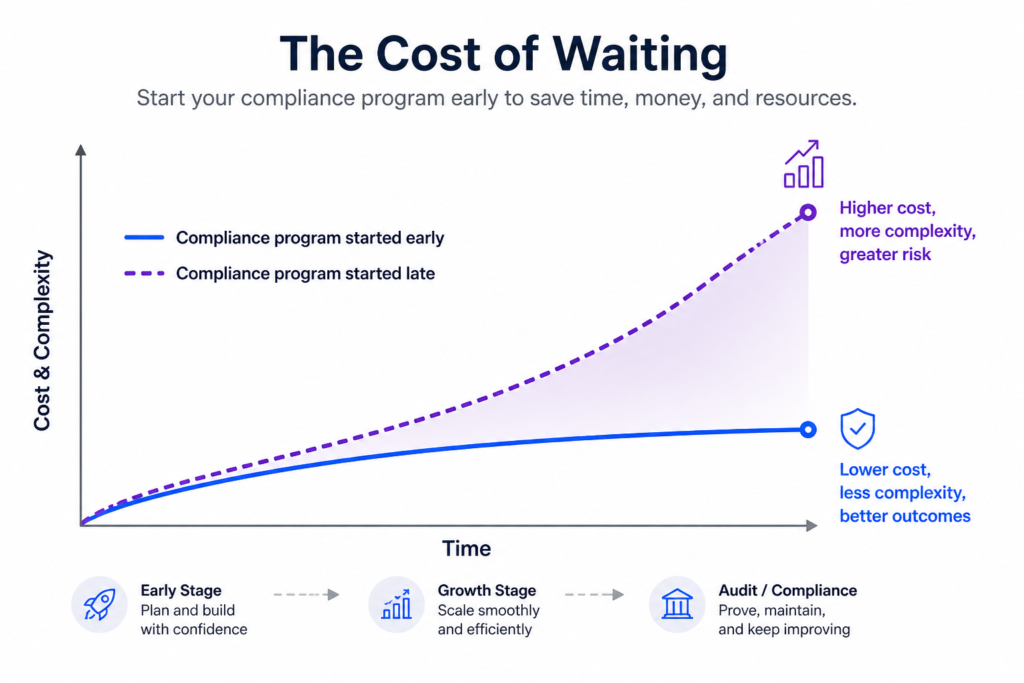
This debt compounds. A startup with 8 employees that begins a SOC 2 program has a relatively clean slate to document. A company with 45 employees that has never formally reviewed access controls has three to four years of user provisioning records, system integrations, and vendor relationships to retroactively organize before an auditor can begin their evaluation.
Founders who start compliance programs at 50 employees regularly discover that remediation work — fixing the debt that accumulated before the program started — adds three to six months to their audit timeline compared to companies that built controls earlier.
3. The Operational Drag Cost
Security questionnaires are the most visible form of this cost, but they are not the only one. In the absence of a compliance program, every enterprise prospect triggers a custom security review process. Sales engineers are pulled into calls to explain security architecture. CTOs write one-off answers to technical questions. Legal teams review custom security addenda that would be unnecessary with a standard audit report.
Quantifying this precisely is difficult because it appears in time allocations rather than budget lines. A reasonable estimate for a growing SaaS company without a compliance program: 40 to 80 hours of senior technical and legal time per quarter, allocated to ad hoc security review work. At blended rates, that is $15,000 to $35,000 annually in opportunity cost before you’ve lost a single deal.
The Questionnaire Paradox
The companies that need a SOC 2 program most urgently — those actively pursuing enterprise deals — are also the ones that can least afford the time to build one reactively. The only way out of this paradox is to start before the questionnaire arrives, not in response to it.
Why ‘We’ll Do It at Series B’ Is a Costly Strategy
The Series B trigger is one of the most common compliance delay rationalizations in early-stage SaaS. The logic sounds reasonable: we’ll have more resources then, we’ll have a proper security team, we’ll have more to protect. Each of those premises is partially true and entirely beside the point.
By the time you close a Series B, you will typically have 30 to 80 employees, multiple enterprise contracts, a complex cloud infrastructure, and a dozen vendor integrations. The gap assessment that would have taken two months at 15 employees takes six months at 60. The control implementation that was straightforward with a small engineering team is now a change management project with a larger one.
More importantly, you will have missed enterprise deals — and missed them invisibly — throughout the period between your current stage and the funding event. The revenue you could have closed, hadn’t you been in the ‘pending security review’ column, is gone. It is not recoverable at Series B.
The right time to start is not when you have maximum resources. It is when you have minimum complexity and maximum leverage, which is almost always earlier than when founders act on it.
What the Right Starting Point Actually Looks Like
You do not need a dedicated security team to start a SOC 2 program. You do not need to buy a compliance automation platform on day one. You do not need an auditor in the room before you understand your own security posture.
What you do need is an honest gap assessment: a structured review of where your organization stands against the control areas an auditor will evaluate. That assessment tells you what is already in place, what needs to be documented, what needs to be built, and what the realistic path to an audit looks like from your current position.
With that information, you can make an informed decision about timeline, budget, and resource requirements — rather than estimating blindly and discovering the gaps when an auditor finds them.