
If your SaaS product touches protected health information in any way — whether you process it, store it, transmit it, or have access to systems that contain it — HIPAA compliance for SaaS is not optional. It is a legal obligation that attaches the moment your product enters a healthcare organization’s environment. For founders building in health tech, understanding what compliance actually requires — not just what it sounds like — is the difference between a defensible program and a liability waiting to surface.
This post covers what HIPAA requires for SaaS companies, the specific rules that apply to your business model, and what a real compliance program looks like beyond the standard policy template.
Are You a Covered Entity or a Business Associate
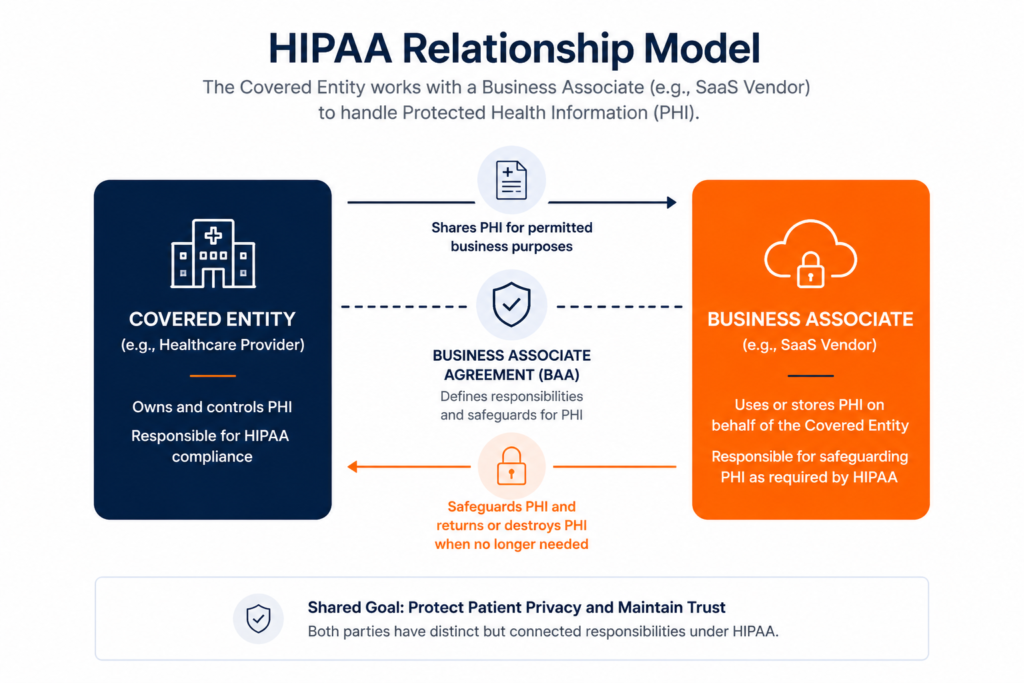
HIPAA organizes its compliance obligations around two categories: covered entities and business associates. Understanding which category applies to your company determines what you are required to do.
Covered entities are the primary handlers of protected health information — healthcare providers, health plans, and healthcare clearinghouses. Most SaaS companies are not covered entities.
Business associates are organizations that handle protected health information on behalf of a covered entity in the course of performing a service. If your SaaS product stores, processes, or transmits patient data on behalf of a hospital, insurance company, or healthcare provider, you are a business associate. That classification carries its own set of obligations, including the requirement to sign a Business Associate Agreement with every covered entity you serve and to comply with the HIPAA Security Rule in full.
The business associate relationship is where most SaaS companies first encounter HIPAA — usually when a healthcare client requests a BAA before signing a contract. That request is not a formality. Signing a BAA without a compliant security program in place creates legal exposure for both parties.
What the HIPAA Security Rule Actually Requires
The HIPAA Security Rule establishes national standards for protecting electronic protected health information, known as ePHI. It applies to all business associates and requires implementation of administrative, physical, and technical safeguards designed to ensure the confidentiality, integrity, and availability of ePHI.
Administrative safeguards include a security management process — including a formal risk analysis and risk management program — security awareness training for all workforce members, contingency planning for emergencies that affect ePHI, and evaluation procedures to assess how well your security policies are working.
Physical safeguards cover the physical controls that limit access to systems containing ePHI — workstation security, device and media controls, and facility access controls.
Technical safeguards address the technology controls that protect ePHI — access controls, audit controls, integrity controls, and transmission security, including encryption.
The Security Rule does not specify exactly how these safeguards must be implemented. It uses a mix of required and addressable specifications, which gives organizations flexibility to implement controls appropriate to their size, complexity, and risk profile. That flexibility is frequently misunderstood as permission to do less — it is not. Addressable specifications still require implementation unless you can document a specific, justified reason why an alternative measure better satisfies the standard.
HIPAA Compliance SaaS: The Risk Analysis Requirement
The most foundational — and most frequently neglected — requirement in the HIPAA Security Rule is the risk analysis. The Security Rule requires every covered entity and business associate to conduct an accurate and thorough assessment of the potential risks and vulnerabilities to the confidentiality, integrity, and availability of all ePHI it creates, receives, maintains, or transmits. This is not a checkbox exercise. A defensible risk analysis identifies where ePHI exists in your environment, evaluates the threats to that information and the likelihood and impact of those threats, and documents your current controls and their adequacy. The output drives your risk management program — the ongoing process of implementing safeguards to reduce identified risks to a reasonable and appropriate level.
Office for Civil Rights enforcement actions consistently cite inadequate risk analysis as the primary finding in breach investigations. Of the 30 largest HIPAA settlements in the last decade, the majority included a risk analysis failure as a contributing factor.
The Business Associate Agreement — What It Commits You To
A Business Associate Agreement is a legally binding contract between a covered entity and a business associate that establishes the permitted uses and disclosures of protected health information, requires the business associate to implement appropriate safeguards, and allocates breach notification obligations.
When you sign a BAA with a healthcare client, you are making specific commitments about how you protect their patients’ data. If your security program does not support those commitments — if you do not have the required administrative, physical, and technical safeguards in place — you have created legal exposure that is independent of whether a breach ever occurs.
OCR has issued significant fines to business associates for HIPAA violations, including against SaaS companies. The enforcement trend is toward holding technology vendors accountable for their role in protecting health data, not just the healthcare organizations they serve.
Building a HIPAA Compliance Program That Holds Up
A real HIPAA compliance program for a SaaS company has four components that must all be present and operational.
The first is a current, documented risk analysis — not a template, but an actual assessment of where ePHI exists in your environment and what the risks to that data are.
The second is a set of implemented safeguards — administrative policies, physical controls, and technical measures — that address the risks identified in the analysis. Policies that exist but are not followed do not satisfy the Security Rule.
The third is a workforce training program with documented completion records. Every person who has access to systems containing ePHI must receive HIPAA security awareness training. That training must be renewed when policies change.
The fourth is an incident response and breach notification procedure that meets the HIPAA Breach Notification Rule requirements — including the 60-day notification timeline for reportable breaches affecting more than 500 individuals.
HIPAA compliance for SaaS is not a one-time project. It is an ongoing program that requires annual review and update as your product, infrastructure, and risk environment evolve.
If your SaaS product touches protected health information and you need to understand your compliance obligations clearly, a HIPAA gap assessment gives you a structured starting point.