
When a security incident involves protected health information at your SaaS company, the HIPAA breach notification rule activates a set of mandatory actions with strict timelines and significant penalties for non-compliance. HIPAA breach notification for SaaS business associates is not discretionary — and the consequences of getting it wrong extend beyond your organization to the covered entities and patients affected by the breach.
What Constitutes a HIPAA Breach
The HIPAA Breach Notification Rule defines a breach as an impermissible use or disclosure under the HIPAA Privacy Rule that compromises the security or privacy of protected health information. This definition is broader than most SaaS founders expect.
A breach does not require malicious intent or confirmed data exfiltration. An unauthorized employee accessing patient records out of curiosity, a misconfigured cloud storage bucket that makes ePHI publicly accessible, or a misdirected email containing patient information are all potentially reportable breaches under the Rule.
The Rule provides a limited safe harbor for incidents that qualify as low probability of compromise. To use this safe harbor, the organization must conduct a risk assessment demonstrating that the probability of compromised information being used harmfully is low — considering four factors: the nature and extent of the ePHI involved, who accessed or could have accessed the information, whether the information was actually acquired or viewed, and the extent to which the risk has been mitigated. If the risk assessment does not support a low-probability determination, the incident is treated as a presumptive breach and notification requirements apply.
The HIPAA Breach Notification Timeline
HIPAA breach notification for SaaS business associates involves two separate notification obligations with different timelines. Understanding both is essential — because your obligation as a BA directly affects your covered entity customers’ ability to meet their own deadlines.
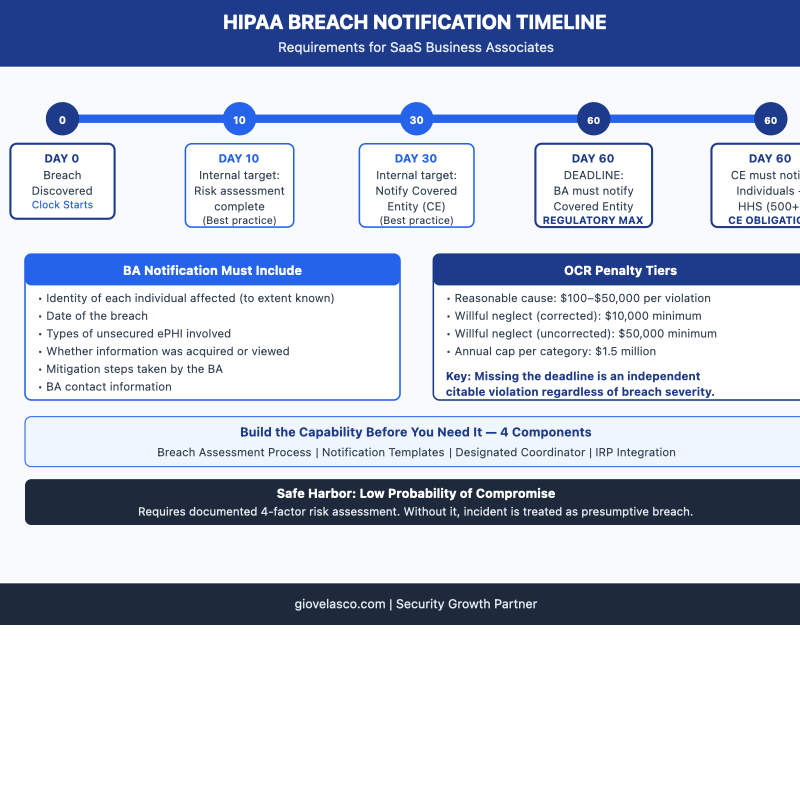
The first obligation is notification to the covered entity. A business associate that discovers a breach must notify the affected covered entity without unreasonable delay and no later than 60 days following discovery. The notification must include the identification of each individual affected to the extent possible, the date of the breach, the types of unsecured ePHI involved, whether the information was acquired or viewed, the covered entity’s mitigation steps taken, and contact information for the business associate.
The second obligation falls on the covered entity — not the business associate — to notify affected individuals and the Department of Health and Human Services. However, the business associate’s notification to the covered entity must be timely enough for the covered entity to meet its own notification deadlines, which are also 60 days from discovery. For breaches affecting 500 or more individuals in a state or jurisdiction, the covered entity must also notify prominent media outlets. For breaches affecting 500 or more individuals nationwide, the HHS Office for Civil Rights must be notified simultaneously with individual notification.
HIPAA Breach Notification SaaS: What Your Business Associate Agreements Must Address
The Business Associate Agreement between your SaaS company and each covered entity you serve must specifically address breach notification obligations. HHS requires BAAs to include provisions establishing the business associate’s obligation to report breaches to the covered entity, the timeline for that notification, and the information that must be included.
BAAs that are vague on notification timelines — stating only that the business associate will “promptly” notify — create ambiguity about what constitutes compliance. The most defensible BAA language mirrors the regulatory 60-day maximum while establishing a shorter internal target — typically 10 to 30 days — that gives both parties time to meet the regulatory deadline without rushing. Review your existing BAAs for notification language. If the notification provisions are vague or absent, renegotiate them before an incident occurs.
Building a Breach Notification Capability Before You Need It
The organizations that handle HIPAA breach notification most effectively are those that build the capability before an incident occurs. Trying to design a notification process while managing an active incident simultaneously is a recipe for timeline violations and documentation failures.
A functional breach notification capability has four components. The first is a documented breach identification and assessment process — a defined procedure for evaluating potential incidents against the breach definition and conducting the low-probability risk assessment when applicable. The second is notification templates for covered entity communication — pre-drafted notification language covering the required content elements, with a clear internal process for review before sending.
The third is a designated notification coordinator — a named person accountable for managing breach notification activities, maintaining the documentation trail, and coordinating with legal counsel and covered entities. The fourth is integration with your incident response plan — breach notification procedures must be embedded in your IRP so that the assessment and notification process activates automatically when a potential breach is identified. For guidance on structuring your incident response policies, see our post on the security policies every SaaS company needs.
The Consequences of Missing HIPAA Breach Notification Deadlines
OCR enforcement of the Breach Notification Rule has produced significant penalties against both covered entities and business associates. Penalties range from $100 to $50,000 per violation, with annual caps of $1.5 million per violation category. The penalty tier depends on the level of culpability — from reasonable cause to willful neglect.
Missing the notification deadline, failing to provide required notification content, or failing to conduct the risk assessment that determines whether an incident is reportable are all independently citable violations. Organizations that discover breaches but delay notification while attempting to limit the scope of disclosure face the highest penalties — willful neglect without timely correction carries minimum penalties of $10,000 per violation.
Building HIPAA breach notification capability is not primarily about avoiding penalties — it is about fulfilling the obligation your BAA creates and protecting the individuals whose information your platform handles. The regulatory consequences are the floor. The reputational consequences of a mishandled breach notification in the healthcare market are far more significant.
Does your SaaS product handle ePHI? A HIPAA gap assessment gives you a clear picture of your current readiness — including your breach notification capability. Book a free 30-minute call at giovelasco.com/contact to get started.
— Giovanni Velasco · CISSP · Security Growth Partner · giovelasco.com