

For most early-stage SaaS companies, the security questionnaire arrives at the worst possible moment — late in a sales cycle, after months of relationship building, with a response deadline of five to ten business days. A strong security questionnaire response for a SaaS startup is not about having a large security team. It is about having a system — a repeatable, document-based process that lets you respond quickly and consistently regardless of who fields the request. This post walks through that system in five practical steps. Before diving in, it helps to understand exactly what procurement teams are looking for — covered in our guide to the 5 security questions enterprise clients ask every SaaS vendor.
Why a Weak Security Questionnaire Response Costs SaaS Startups Deals
Enterprise procurement teams issue security questionnaires to assess vendor risk before committing to a contract. Deals stall for three common reasons: the vendor doesn’t have the documentation to back up their answers, the vendor takes three weeks to respond while procurement’s attention moves elsewhere, or the vendor’s answers are vague and trigger additional follow-up rounds that add weeks to the process. All three of these problems are solved by preparation — not by security headcount. According to NIST’s Cybersecurity Framework, documented processes and consistent evidence are the foundation of a credible security posture.
Step 1: Build a Master Q&A Library
The foundation of any security questionnaire response for SaaS startups is a library of pre-approved answers to the questions that appear most frequently across enterprise clients. Start by pulling together every security questionnaire you have received in the past 24 months. List every unique question — you will find that 70 to 80 percent repeat across different enterprise clients.
For each question, draft a clear, specific answer and have it reviewed by someone with security knowledge. Tag each answer with the evidence type it references: policy document, technical specification, certification report, or process description. Store the library in a shared folder with version control.
Step 2: Create a One-Page Security Overview
A security overview document is a single page — two at most — that summarizes your security posture in plain, non-technical language. It is designed to be attached to a questionnaire response or sent proactively during the sales process without requiring a custom write-up each time. The document should cover six areas: hosting environment, encryption standards (at rest and in transit), access controls including MFA and RBAC, compliance certifications or in-progress status, incident response and notification timeline, and penetration testing cadence. Keep it brief and specific.
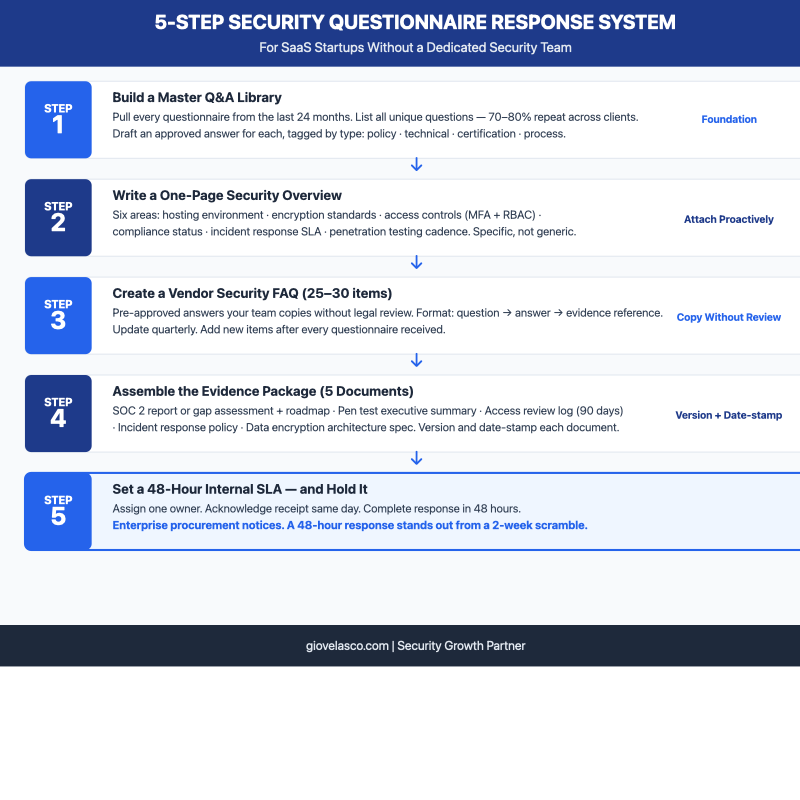
Step 3: Maintain a Vendor Security FAQ Document
The security FAQ is the workhorse of your questionnaire response system. It covers 25 to 30 of the most common questionnaire items with complete, pre-approved answers that your team can copy directly without requiring legal or security review each time. Structure it simply: the question, the answer, and the supporting evidence reference. Update the FAQ quarterly and add new questions after every engagement.
Step 4: Build and Maintain an Evidence Package
Some questionnaire items cannot be answered with words alone. The five documents that cover the majority of evidence requests in any security questionnaire response for SaaS startup teams:
- Your SOC 2 Type II report or, if not yet certified, your gap assessment findings and certification roadmap
- Your penetration testing executive summary from the past 12 months with remediation status for critical and high findings
- An access review log or certification from the past 90 days
- Your formal incident response policy
- Your data processing and encryption architecture specification
Each document should be versioned and date-stamped. Outdated evidence is worse than no evidence — it signals that your security program is not actively maintained.
Step 5: Set a 48-Hour Internal SLA
Speed is itself a signal of organizational maturity. A vendor that responds to a security questionnaire completely and accurately within 48 hours stands out. Assign a single owner for questionnaire responses. Create a simple routing process so that when a questionnaire arrives, it reaches the right person within hours, not days.
If the questionnaire is significantly more complex than your FAQ covers, acknowledge receipt immediately, provide an estimated completion date, and send your security overview document while you work on the custom items. This is the core discipline of a strong security questionnaire response process for a SaaS startup: respond fast, document thoroughly, and keep the conversation active. For context on how procurement teams evaluate your response, see our post on why SaaS startups lose enterprise deals during procurement.
Need this system built for your company? I build security documentation packages — Q&A library, FAQ, evidence package — as part of the SOC 2 readiness program. Two to three weeks to complete. Learn more at giovelasco.com/services.