
Who Sends These Requests — and Why Now
The request rarely comes from a technical contact. It typically comes from someone in procurement, legal, or vendor risk management — people whose job is to protect their organization from third-party exposure. They are not evaluating your product’s features. They are evaluating whether your company is a manageable risk. This is the moment SOC 2 compliance for SaaS companies goes from a background concern to an immediate operational priority.
The volume of these requests has increased sharply over the past four years. Three forces are driving it. First, enterprise companies have significantly hardened their vendor onboarding requirements after a series of high-profile supply chain incidents. Second, cyber insurance underwriters now scrutinize vendor ecosystems more aggressively, which pushes that scrutiny down to software providers. Third, privacy regulations like GDPR and CCPA have made organizations more careful about which third parties touch their data.
The result is now a standard requirement for SaaS companies at $1M ARR and up — sometimes lower, depending on the buyer.
What SOC 2 Compliance Means for a SaaS Company
SOC 2 stands for System and Organization Controls 2. The American Institute of Certified Public Accountants (AICPA) developed a framework that evaluates whether a service organization’s controls over security, availability, processing integrity, confidentiality, and privacy meet a defined standard.
The keyword is controls. SOC 2 is not a certification you earn by checking a list of requirements. It is an independent auditor’s opinion on whether your organization has designed and implemented the controls it says it has. The distinction matters more than most founders realize.
What SOC 2 is not: it is not a government mandate, not a guarantee of zero breaches, and not proof that your product has no vulnerabilities. What it is: structured, third-party evidence that your organization takes information security seriously and has built systems to manage it consistently.
Why Enterprise Buyers Require It
Procurement and legal teams at enterprise companies can’t evaluate every vendor’s security posture from scratch. A SOC 2 Type II report from an accredited auditor is the shorthand they rely on to make vendor decisions at scale. Without it, you become a liability in their risk register — not a partner.
for this block. Use this space for describing your block. Any text will do. Description for this block. You can use this space for describing your block.
The Cost of Saying ‘We’re Working on It’
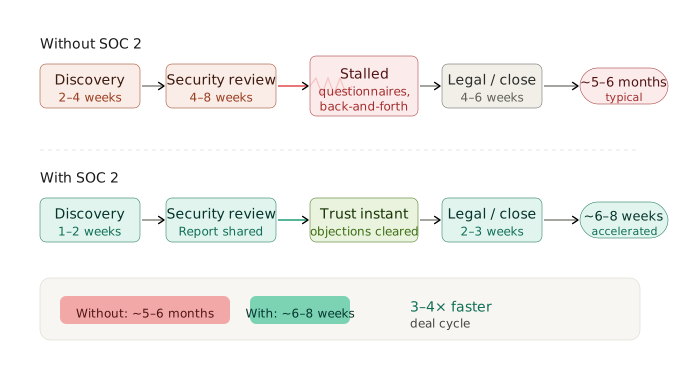
Every week a deal sits waiting for compliance documentation is a week where a competitor with a completed audit has the advantage. The buyer doesn’t say, ‘we’re going with someone else because you failed the security review.’ They just go quiet.
Beyond the immediate deal impact, there is a compounding cost to delay. The longer you wait to start a SOC 2 program, the more complex and expensive it becomes. The security controls you have to document, implement, and test over a 12-month observation period are much harder to build when your product and team have tripled in size from what they were when you started.
The internal distraction is another cost. Without a formal security program, your team answers ad hoc security questionnaires from every prospect manually. Sales engineers spend hours writing the same answers in slightly different formats. That time compounds fast.
What a Realistic Timeline Looks Like
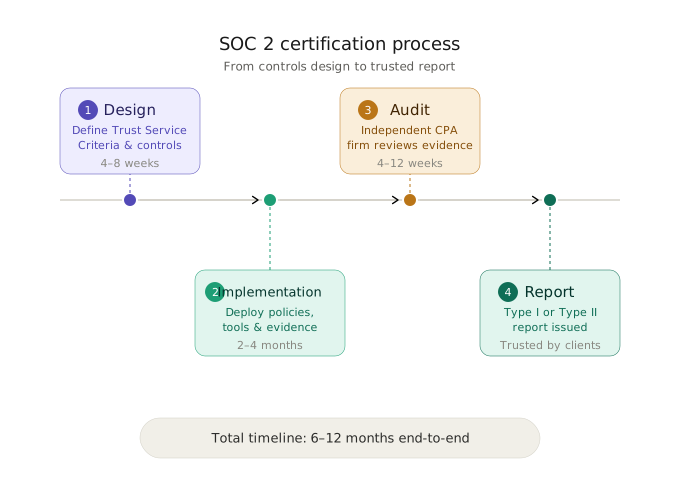
Let’s address the misconception that dominates most founder conversations about SOC 2: that it takes two years and requires a dedicated security team.
A realistic timeline for a focused, well-managed SOC 2 Type II readiness program at an early-stage SaaS company looks like this:
- Months 1–2: Gap assessment, policy documentation, control implementation
- Months 3–5: Evidence collection, access reviews, vendor assessments
- Months 6–12: Observation period (auditor watches controls in operation)
- Months 12–14: Audit fieldwork and report issuance
The total elapsed time from a standing start to an issued Type II report is typically 12 to 16 months. A Type I report covers control design without the observation period, and it can be completed in 3 to 5 months, though most enterprise buyers require Type II for ongoing contracts. Check this article to know the difference between type I and type II reports.
The variable that changes those timelines most significantly is how prepared your organization is at the starting line. Companies that begin with a thorough gap assessment compress the process considerably compared to those that discover major remediation work mid-audit.
The Most Important First Step
Before you engage an auditor, before you buy a compliance automation platform, and before you budget for the process, you need an honest, detailed assessment of where your organization actually stands. That means looking at your current security controls, policies, access management practices, vendor relationships, and incident response capabilities against the criteria an auditor will use.
Most founders are surprised by what they find. Not because their security is poor — often it’s reasonable for their stage — but because it’s undocumented, informal, or inconsistently applied. An auditor can only evaluate what’s written down and demonstrably in practice.
Final Thought
The enterprise client who just asked for your SOC 2 report is not trying to create an obstacle. They are telling you something important: your product is interesting enough to them that they are willing to go through a formal security review to consider buying it. That is a buying signal, not a red flag.
The question is whether your organization is ready to meet them where they are — or whether this is the moment you decide to become the company that always has the answer ready.