
The ISO 42001 certification business value question has come up in maybe 30 conversations I’ve had with organizations this year, and it’s usually phrased bluntly: “Should we pursue certification, or is this just compliance theater?” Here’s my honest answer: it depends on your market and your risk appetite — and unlike most consultants, I’ll tell you the specific conditions under which the answer is no. This article gives you the decision matrix I use with clients, real cost ranges, and the distinction that matters more than any other: building the framework versus certifying it.
The Distinction That Reframes the Question
ISO 42001 is two separable things. It’s a framework — an AI management system covering risk assessment, governance roles, transparency, and monitoring — and it’s a certificate, a third-party attestation that the framework operates. The framework delivers most of the operational value: fewer AI surprises, clear accountability, defensible answers when customers ask how you govern AI. The certificate delivers market value: proof you can hand to a procurement team without opening your internals.
That separation matters because you can capture the operational value without the audit cost, and upgrade to certification when the market demands it. The organizations that get this wrong buy the certificate first and backfill the framework — which is how you end up with compliance theater, the exact thing skeptics suspect. Built risk-first, the way I described in my risk-driven implementation guide, the framework pays for itself whether or not an auditor ever sees it.
Pursue Certification If…
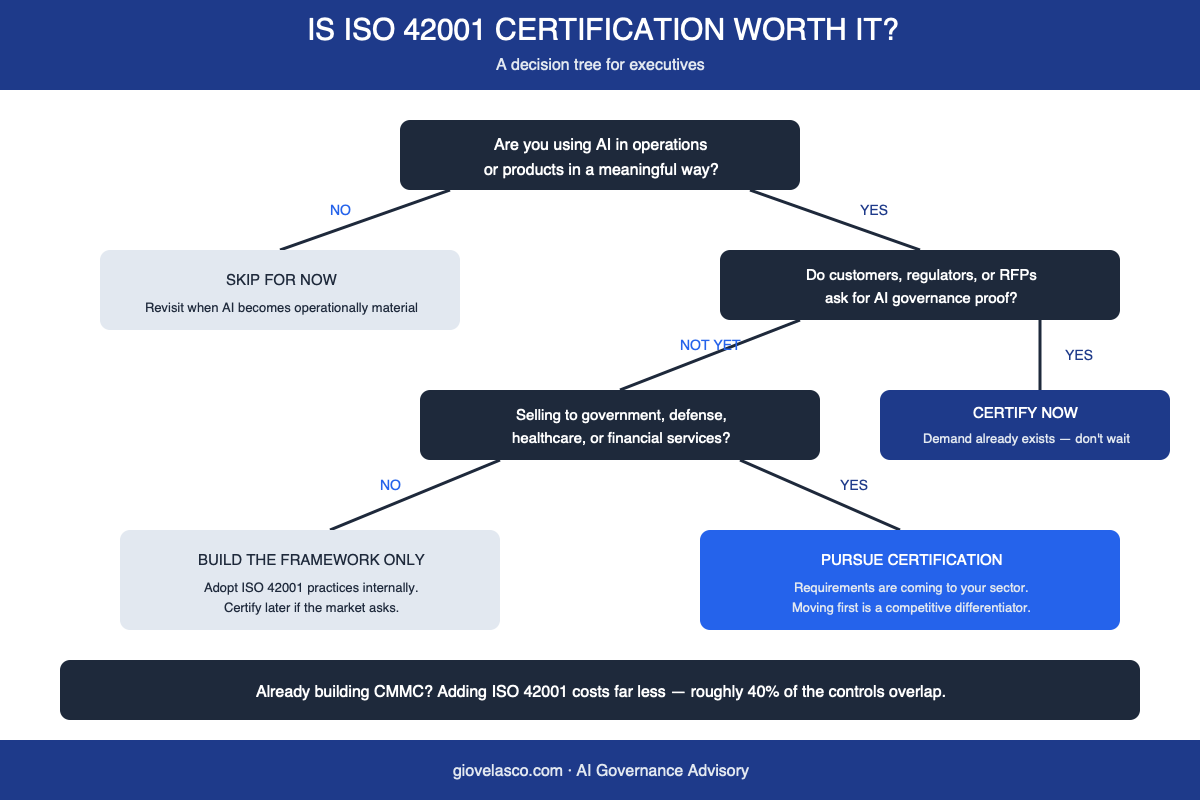
- You sell to government agencies. AI governance language is already appearing in federal RFPs, and a certificate is the shortest credible answer to it.
- You handle sensitive data with AI — CUI, patient data, financial records feeding models. The certificate pre-answers the hardest due-diligence questions.
- Customers are asking for AI governance proof. If it’s in your security questionnaires now, it will be contractual within a renewal cycle or two.
- You want differentiation that competitors can’t fake quickly. Certification takes months; a claim on a website takes minutes. Procurement teams know the difference.
Skip It (For Now) If…
- You’re not using AI meaningfully. Certifying governance over AI you barely use is genuine theater. Revisit when AI becomes operationally material.
- Your compliance burden is already maxed. If your team is mid-CMMC-sprint with a November deadline, adding an audit now steals capacity from the requirement that has enforcement teeth. Build the framework; certify next year.
- Nobody in your market is asking. A certificate no customer requested is a cost center. Watch your RFPs and questionnaires — they’ll tell you when the timing changes.
The ISO 42001 Certification Business Value Math
Real numbers, from engagements I’ve seen. Building the framework for a mid-size organization: roughly $15K–$40K in advisory and internal time over three to five months, scaled by how much AI you actually use. Certification on top: audit fees typically $10K–$25K depending on scope and certification body, plus surveillance audits in years two and three, plus the internal cost of audit preparation. Call the full certified path $30K–$70K over three years for most mid-size organizations.
Against that: what’s one deal worth where AI governance proof was the differentiator — or the disqualifier? For defense contractors and health-adjacent SaaS companies, a single contract usually dwarfs the entire program cost. That’s the honest ROI structure: the framework is cheap insurance with operational payback, and the certificate is a market-access bet that pays off in sectors where the requirement is arriving. Here’s what I’ve noticed across those 30 conversations: organizations that pursued ISO 42001 proactively found value, because they built it around real risks. Organizations that did it only because an RFP forced them checked the box and moved on — and got checkbox value.
The Special Case: Contractors Already Building CMMC
For Tier 2 and Tier 3 defense contractors already building CMMC compliance, the math shifts decisively. Roughly 40% of the ISO 42001 workload — risk assessment machinery, access control, incident response, training, governance structure — rides on infrastructure your CMMC program already requires. The incremental cost of adding the AI management layer while those systems are being built is a fraction of a standalone implementation. You might as well do both: the standard is new enough that certified suppliers are rare, and in a defense supply chain that’s about to care deeply about AI governance, rare is valuable.
How to Decide This Quarter
Run three checks. Pull your last ten security questionnaires and RFPs and count AI governance questions — that’s your demand signal. Inventory your actual AI use — that’s your materiality signal. Price the incremental cost given whatever compliance machinery you already run — that’s your efficiency signal. Strong demand plus material AI use: certify. Material AI use but quiet market: build the framework, defer the audit. Neither: document the decision and revisit in two quarters. Certification is valuable when it solves a real problem — market access, customer trust, regulatory positioning. It’s theater only when it solves nothing you can name.
If you want to run this analysis against your actual pipeline and compliance roadmap — with real numbers instead of ranges — schedule a discovery call. Thirty minutes, and you’ll leave with a defensible yes, no, or not-yet.