
An AI governance framework built as risk management solves real business problems; one built as a compliance checkbox solves nothing and annoys everyone. I talked to a manufacturing director last week who put it bluntly: “ISO 42001 sounds like compliance theater. We need AI to stay competitive. Are you going to tell us we can’t use it?” No. The opposite, actually — and that misconception is worth dismantling carefully, because it keeps organizations from building the one thing that would let them adopt AI faster with fewer surprises. This article reframes AI governance as what it actually is: business risk management, applied to a technology most companies are already using in more places than leadership knows.
Governance Is Not Gatekeeping
ISO 42001 isn’t a gatekeeping standard. It’s a framework for using AI intentionally. It says: use AI — but know where you’re using it, assess what could go wrong, control those risks, and monitor to make sure the controls work. That’s not theater. That’s the same discipline you already apply to financial controls, safety programs, and quality management. Nobody calls ISO 9001 “quality theater” because it makes defect rates visible; the same logic applies here.
The organizations I work with that built real AI governance frameworks are accelerating their AI adoption, not throttling it. They’re not guessing about which use cases are safe. They’re not surprised by model failures. They’re not exposed when a customer or regulator asks how a model made a decision. Confidence is a speed advantage, and governance is where the confidence comes from.
Step One: Find Out Where You’re Actually Using AI
Every AI governance engagement I run starts with an inventory, and every inventory surprises the leadership team. The sanctioned projects are easy — the demand forecasting model, the quality inspection system. What surfaces next is the shadow layer: sales reps drafting proposals with public chatbots, engineers pasting code into AI assistants, HR screening resumes with an AI feature that shipped inside software nobody evaluated. In a typical mid-size company, the real AI footprint runs two to three times the official one.
You cannot govern what you haven’t found. The inventory exercise is simple: survey every department, list every tool with an AI capability, and record what data flows into each. For defense contractors, that last column matters enormously — the moment controlled unclassified information touches an unapproved AI tool, you have a security incident, not a productivity win. I covered that collision in detail in my article on ISO 42001 for defense contractors.
Step Two: Assess Risk Like It’s a Business Question — Because It Is
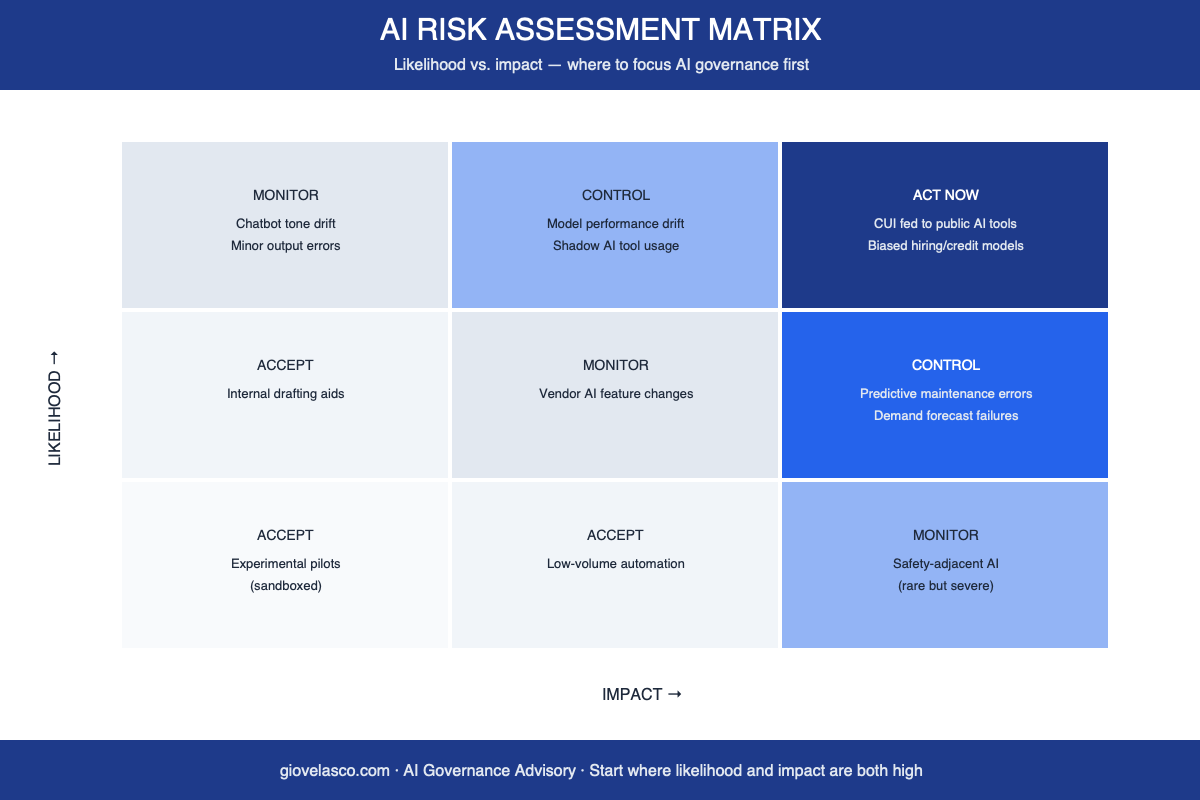
For each AI use you’ve inventoried, ask two questions: how likely is this to go wrong, and how much does it hurt when it does? That’s it. A likelihood-versus-impact grid sorts your entire AI portfolio into four postures:
- Act now — high likelihood, high impact. CUI or customer data flowing into public AI tools. Models influencing hiring or credit decisions with no bias review. These get controls this month, not this quarter.
- Control — one dimension high. Production models that drift quietly, like a demand forecaster degrading as market conditions shift. Scheduled monitoring and defined owners.
- Monitor — worth watching. Vendor AI features that change under you, low-stakes chatbots. Someone owns the watchlist.
- Accept — low likelihood, low impact. Sandboxed pilots, internal drafting aids. Document the acceptance and move on. Governance that can’t say “this risk is fine” isn’t governance; it’s bureaucracy.
Step Three: Design Controls That Solve Named Problems
Here’s what separates working AI governance frameworks from shelf-ware: every control maps to a risk somebody actually named. The organizations I’ve watched succeed weren’t chasing an abstract standard. Model bias was costing one of them customer trust — so they built bias review into their release process. A customer contractually required decision transparency from another — so they built model documentation. Performance drift was creating operational risk at a third — so they built monitoring with thresholds and alerts.
ISO 42001 gives you the scaffolding to address these problems systematically — the standard is genuinely useful as an organizing structure. But the sequence matters: start with risk, let compliance follow. Organizations that start with compliance produce impressive-looking documents describing controls nobody operates. Organizations that start with risk produce modest documents describing controls that run every week — and when certification time comes, the second group passes faster, because auditors can tell the difference immediately.
The Minimum Viable AI Governance Framework
For a mid-size business, the starting kit is four artifacts and one meeting. The artifacts: an AI inventory with data flows; a one-page AI policy stating what’s allowed, what’s prohibited, and who approves exceptions; a risk register sorting your AI uses into the four postures above; and monitoring notes for whatever landed in your top-right quadrant. The meeting: a quarterly review where the inventory gets updated, new tools get triaged, and drift metrics get eyeballed. That’s a governance program. It costs a few days to stand up and a few hours a quarter to run — and it scales into full ISO 42001 certification later without rework, because it’s built on the same risk-first spine.
The competitive framing is worth stating plainly: ISO 42001 is a competitive advantage dressed up as compliance. While your competitors are either banning AI out of fear or adopting it blindly, a working AI governance framework based on risk management lets your business do neither — you adopt fast, with your eyes open, and you can prove it to any customer who asks. If you want help building that — the inventory workshop, the risk assessment, the policy — schedule a discovery call. Let’s build it for you.