
ISO 42001 AI governance defense contractors conversations used to be theoretical. Not anymore. Here’s what I’m seeing in the market right now: U.S. federal agencies are starting to require documented AI governance in RFPs, and the requirement is flowing down through prime contractors to their supply chains — the same path CMMC took. If your company uses AI anywhere in operations, whether it’s predictive maintenance on the shop floor or a chatbot in customer service, you’re going to be asked to prove you govern it. This article explains what ISO 42001 actually requires, why it matters to defense contractors specifically, and how to build it alongside your CMMC work instead of after it.
What ISO 42001 Actually Is
ISO/IEC 42001 is the international standard for AI management systems — the AI equivalent of what ISO 27001 is for information security. Two years ago nobody was asking for it. Now it’s the framework buyers reach for when they need a vendor to prove responsible AI use, because it’s the only certifiable, auditable standard available.
The standard asks four questions that sound simple and get uncomfortable fast:
- How do you identify and manage AI risks? Not hypothetically — where is your inventory of AI systems, and where are the documented impact assessments?
- How do you ensure transparency in AI-assisted decisions? When a model influences a quote, a schedule, or a hiring decision, can you explain how?
- How do you audit models for bias and performance drift? Models degrade. Who notices, and what’s the process when they do?
- Who owns accountability when something goes wrong? “The algorithm decided” is not an accountability structure.
For most organizations I talk to, the honest answer to all four is: we don’t know yet. You have data security controls. You don’t have AI-specific governance. That’s the gap ISO 42001 exists to close.
Why ISO 42001 AI Governance Hits Defense Contractors First
Defense contractors sit at the intersection of three pressures that make AI governance arrive early. First, federal procurement: agencies are writing AI governance language into RFPs now, and primes pass requirements downstream because their own compliance depends on it. Second, CUI exposure: if any AI tool in your environment touches controlled unclassified information — an engineer pasting drawing specs into a public chatbot is the nightmare scenario — you have a CMMC problem and an AI governance problem simultaneously. Third, operational AI is already in your plants: demand forecasting, predictive maintenance, quality inspection vision systems. These aren’t experiments anymore; they’re production systems making decisions that affect deliveries to the DoD supply chain.
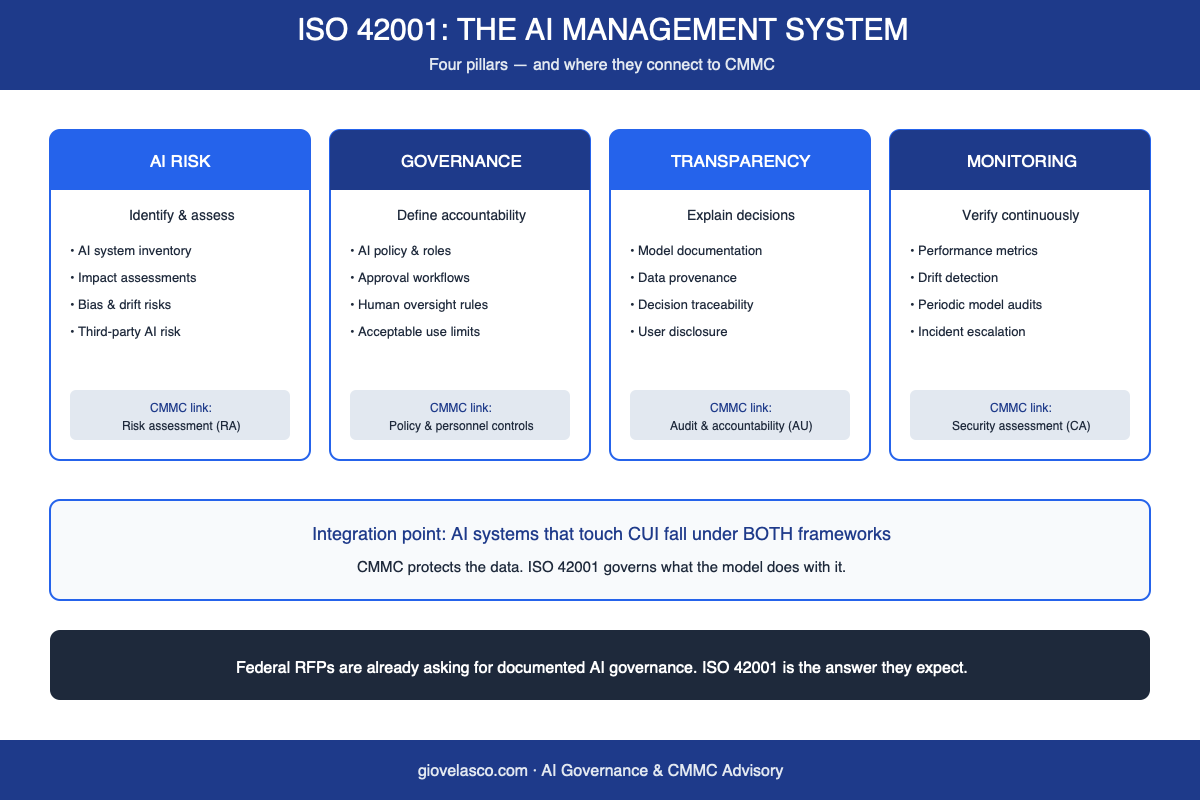
Here’s the scenario I walk clients through. You’re a Tier 2 contractor using predictive analytics to forecast demand. That model trains on historical data that includes CUI. CMMC governs how you protect that data. ISO 42001 governs how the model uses it and how its outputs get supervised. You need both, and pretending otherwise just means discovering the second requirement during a contract negotiation.
The Four Pillars, In Practice
AI risk management starts with an inventory. Most organizations discover they’re using two to three times more AI than leadership thought, once shadow tools are counted. Each system gets an impact assessment: what does it decide, what data feeds it, what happens when it’s wrong.
Governance means an AI policy with named roles: who approves new AI use, what’s prohibited, where human review is mandatory. This is organizational plumbing, not data science — which is why it can move fast once leadership commits.
Transparency requires documentation: what each model does, what data trained it, and how its decisions can be traced. If a customer asks why your AI-assisted quote came out the way it did, “we can’t tell” is a relationship-ending answer in defense work.
Monitoring closes the loop: performance metrics, drift detection, periodic model audits, and an escalation path when something looks wrong. If this sounds structurally identical to security monitoring under CMMC, that’s exactly the point — and exactly the opportunity.
Building It Alongside CMMC, Not After
The contractors moving first aren’t running two separate compliance programs. They’re extending the machinery they’re already building for CMMC. Your risk assessment process gains an AI category. Your incident response plan gains AI failure scenarios. Your training program gains an AI acceptable-use module. Your audit calendar gains model reviews. In my experience roughly 40% of the ISO 42001 workload rides on infrastructure a CMMC program already requires — the integration logic I detail in my article on CMMC readiness for the defense supply chain.
The sequencing matters. Bolting AI governance on after your CMMC program is built means re-opening documents, retraining staff, and re-auditing processes you just finished. Building both at once costs perhaps 20% more effort than CMMC alone. Building them separately costs closer to 70% more.
Where to Start This Quarter
Three moves, in order. First, inventory your AI use — all of it, including the unsanctioned tools your teams adopted on their own. You can’t govern what you haven’t found. Second, write the one-page AI policy: what’s allowed, what’s prohibited, who approves exceptions, and an explicit rule about CUI never entering unapproved AI tools. Third, pick your highest-impact AI system and run a single documented risk assessment on it. Those three artifacts — inventory, policy, first assessment — are the seed of an ISO 42001 program and immediately usable answers when an RFP asks about AI governance.
AI governance isn’t a future concern for defense contractors — and here’s the timing detail worth noticing: while CMMC’s third-party certification track has been paused since July 2026, ISO 42001 certification is fully available today. The contractors who treat ISO 42001 AI governance as part of the same readiness push will answer RFP questions their competitors can’t. If you want to figure out what that looks like for your organization, schedule a discovery call — bring your AI tool list, and we’ll sketch the program in one session.