
Most security roadmaps are built backwards. They start with a compliance framework, map the required controls, and produce a project plan for implementing them. The result is a roadmap that satisfies an auditor’s checklist but does not connect to the business outcomes that justify the investment. A security roadmap for SaaS companies that produces measurable business results starts from the other direction — from your business goals, identifies the security investments that directly enable those goals, and sequences the work accordingly.
This post explains how to build a security roadmap that your executive team will fund and your enterprise buyers will recognize. For SaaS companies at the beginning of this journey, our post on SOC 2 readiness and the enterprise sales cycle provides the compliance foundation that most roadmaps build on.
Why Most Security Roadmaps Do Not Produce Business Results
A security roadmap driven purely by compliance requirements will reliably produce a compliant organization. What it will not reliably produce is a competitive advantage, faster deal velocity, or stronger enterprise sales positioning — because compliance checklists are not designed with those outcomes in mind.
The disconnect is structural. Compliance frameworks are designed to reduce risk and establish minimum security standards. They are not designed to optimize for the business outcomes that B2B SaaS companies care about. When a founder asks “what do I need to do to close this enterprise deal?” the answer from a compliance framework is “implement all of these controls.” The answer from a business-aligned security roadmap is “here are the three things that will satisfy this specific buyer’s requirements within 60 days, and here is the longer-term program that makes every subsequent enterprise deal easier.”
Building a security roadmap for SaaS companies requires integrating two inputs: the compliance and control requirements that define the floor — frameworks like the NIST Cybersecurity Framework and the CIS Controls — and the specific business goals that define the ceiling.
How to Structure Your Security Roadmap
An effective security roadmap organizes work across four parallel tracks that advance simultaneously rather than sequentially.
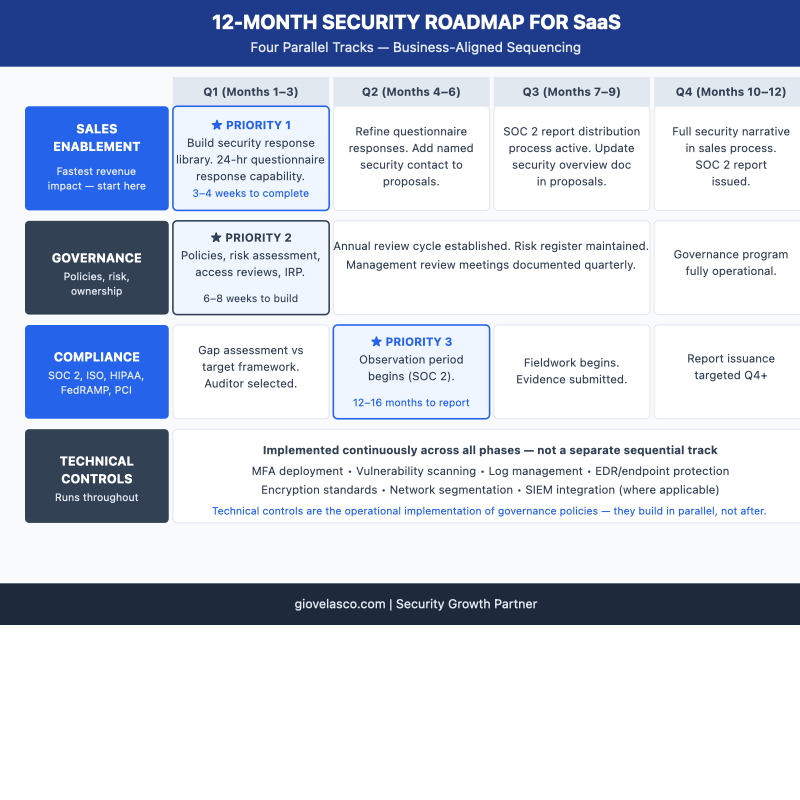
The governance track covers the foundational program elements: policy documentation, risk assessment, ownership assignment, and management review processes. This track produces the organizational infrastructure that everything else builds on. Governance work is never finished — it requires annual review and maintenance — but the initial build takes six to eight weeks for most organizations.
The compliance track covers the certification work required by your buyer profile: SOC 2 readiness, ISO 27001, HIPAA, FedRAMP, or PCI DSS, depending on your market. This track has the longest timeline and the most external dependencies. Starting it early and maintaining it as an ongoing program — not a one-time project — is the defining characteristic of organizations that stay ahead of buyer requirements.
The technical controls track covers the implementation of specific security tools and configurations: MFA deployment, vulnerability scanning, log management, endpoint protection, encryption standards, and network segmentation. This track is where your engineering team does most of the hands-on work. The sales enablement track covers the documentation and processes that make your security program visible to buyers — the security response library, the SOC 2 report distribution process, the security overview document in proposals, and the named security contact who joins due diligence calls.
Security Roadmap SaaS: Sequencing Based on Business Impact
The sequencing of your security roadmap should prioritize the investments that produce the fastest and most direct business impact first. For most B2B SaaS companies in active enterprise growth mode, that sequence starts with sales enablement — building the security documentation package that allows your team to respond to questionnaires in 24 hours and satisfy mid-market buyers without a SOC 2 report. This investment pays back immediately in deal velocity and requires three to four weeks to complete.
The second priority is the governance foundation — policies, risk assessment, access review processes, and incident response procedures. This work takes six to eight weeks and produces the documentation foundation that SOC 2 and other compliance programs build on. The third priority is the compliance program itself — SOC 2 readiness, with the observation period beginning as soon as the governance foundation is solid. This investment takes 12 to 16 months to produce a Type II report, but the business impact of being able to answer “yes, we have a SOC 2 Type II report” in an enterprise deal is significant. Technical controls are implemented throughout all three phases.
How to Connect Your Security Roadmap to Revenue Goals
The most effective way to build executive support for a security roadmap is to connect each investment directly to a revenue outcome. The sales enablement track should be presented as a deal velocity investment: based on your current pipeline, how many deals are in security review at any given time, and what is the average delay those reviews create? A 14-day average delay across 10 active enterprise deals represents 140 days of lost deal velocity per quarter. A security response library that reduces that delay to two days produces a measurable, quantifiable impact.
The SOC 2 readiness investment should be presented against the average contract value of deals that require it. If three enterprise deals in your current pipeline are conditional on a SOC 2 report, and those deals average $80,000 in ACV, the revenue at risk from not having the report is $240,000 annually — before considering the deals you never hear about because your company is screened out of RFPs that require a SOC 2 report as a submission requirement. A security roadmap for SaaS companies that connects investments to revenue outcomes is a document your executive team funds. A security roadmap that lists compliance requirements without business context is a document your executive team files.
The Role of Security Leadership in Roadmap Execution
A security roadmap without ownership does not get executed. The most common failure mode is a well-designed roadmap that produces no results because no single person has clear accountability for driving it forward.
For SaaS companies without a full-time CISO, the vCISO model is the most practical way to assign roadmap ownership. A credentialed fractional security leader who owns the roadmap, reports progress to the executive team, manages the compliance program, and serves as the named security contact for enterprise buyers provides the accountability structure that roadmap execution requires — without the full-time hire cost. For a detailed overview of how vCISO engagements are structured for SaaS companies, see our post on vCISO services for SaaS companies.
The security roadmap and the vCISO engagement are complementary investments: the roadmap defines what needs to be done, and the vCISO provides the consistent ownership that ensures it gets done on the timeline your business goals require.
Ready to build a security roadmap that connects directly to your enterprise growth goals? Start with a free 30-minute strategy call at giovelasco.com/contact — we’ll walk through your current posture, your buyer profile, and the investments that produce the fastest business impact. You can also download the free assessment at giovelasco.com/guide to benchmark your current security program.
— Giovanni Velasco · CISSP · Security Growth Partner · giovelasco.com