
Security awareness training for SaaS companies is simultaneously one of the most required and most neglected components of a compliance program. SOC 2 requires it. ISO 27001 requires it. HIPAA requires it. And yet most implementations consist of a 20-minute annual video that employees click through as fast as possible before returning to their actual work.
This post explains what effective security awareness training actually produces, what the compliance frameworks require versus what works, and how to build a program that changes behavior — not just generates completion records. For a broader look at what enterprise security reviewers evaluate in vendor assessments, see our post on what enterprise procurement teams look for in vendor security reviews.
What the Compliance Frameworks Actually Require
The training requirements across the major compliance frameworks are consistent in their core elements: training must occur, completion must be documented, and content must be relevant to the security risks employees face.
SOC 2 evaluates whether your organization communicates security responsibilities to employees and whether those communications are documented. Auditors will request training completion records for all employees and will ask about the content and frequency of training. ISO 27001 Annex A.6.3 requires that all personnel and relevant external parties receive appropriate awareness education and training, and regular updates in organizational policies and procedures relevant to their job function.
HIPAA requires covered entities and business associates to implement a security awareness and training program for all members of the workforce, including management, with documentation of completion. What the frameworks do not prescribe is format, duration, or content specificity. This flexibility is both an opportunity and a risk — organizations have latitude to build effective programs, but many use that latitude to build minimally compliant ones. The SANS Institute’s security awareness resources offer a benchmark for what comprehensive programs look like in practice.
The Four Components of an Effective Security Awareness Training Program
Security awareness training for SaaS teams that actually changes behavior has four components working together, not one annual video.
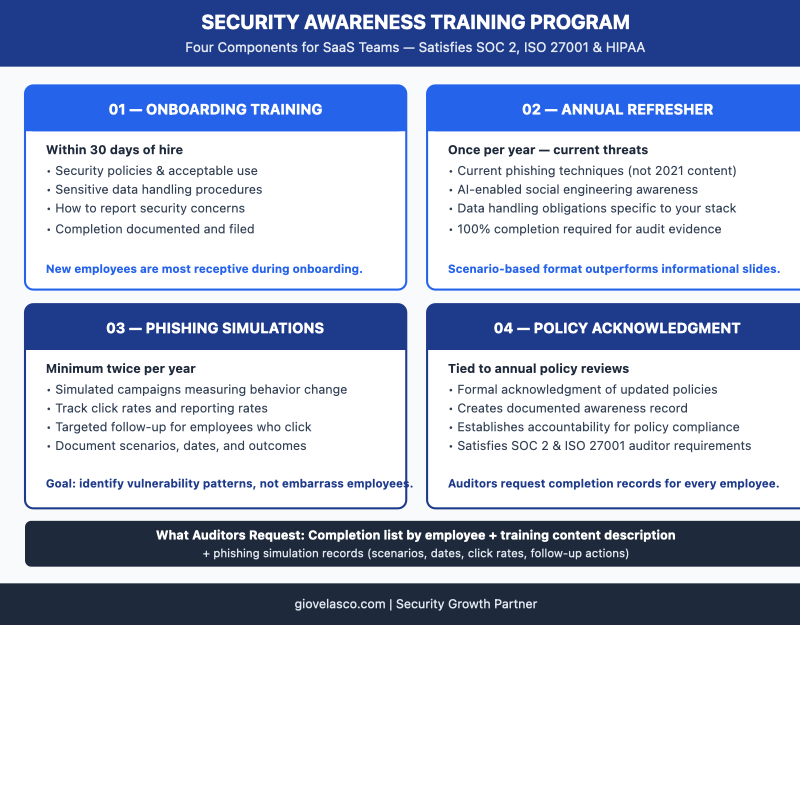
The first is role-specific onboarding training delivered within 30 days of hire. New employees are most receptive to security guidance when they are learning their role. Onboarding training covers your security policies, acceptable use requirements, how to handle sensitive data, and how to report security concerns. Completion is documented and filed.
The second is annual refresher training tailored to current threats. Annual training is most effective when it reflects the actual threat landscape rather than generic security hygiene. A 2026 security awareness session should address current phishing techniques, AI-enabled social engineering, and your specific data handling obligations — not the same module that ran in 2021.
The third is phishing simulation exercises conducted at least twice per year. Simulated phishing campaigns measure whether training is producing behavior change and identify employees who need additional guidance. The goal is not to embarrass employees who click — it is to identify vulnerability patterns and address them with targeted follow-up. For guidance on phishing simulation design, the NIST phishing guidance publication SP 800-177 provides a useful framework.
The fourth is policy acknowledgment tied to policy reviews. When you update your security policies annually, employees should formally acknowledge receipt and understanding. This creates a documented record of policy awareness that satisfies auditor requirements and establishes accountability for policy compliance. For guidance on the underlying security policies every SaaS company needs, see our post on the 7 security policies every SaaS company needs.
Security Awareness Training SaaS: What Evidence Auditors Look For
When a SOC 2 or ISO 27001 auditor evaluates your security awareness training program, they will request specific documentation that many organizations cannot readily produce.
The first request is a list of all employees with their training completion dates for both onboarding and annual training. This needs to show 100 percent completion — any employee without a completion record is a finding. The second is the training content itself or a description of what the training covers. Auditors evaluate whether the content is relevant to the risks your organization faces. Generic cybersecurity training that does not address your specific data types, compliance obligations, or threat environment is less credible than content tailored to your context.
The third is documentation of any phishing simulations — the scenarios used, the date conducted, the click rates, and any follow-up actions taken with employees who failed the simulation. Organizations that maintain this documentation in an organized, current state move through training-related audit evidence requests in minutes. Organizations that scramble to reconstruct completion records spend days.
How to Build Training That Employees Actually Engage With
The most common failure mode in security awareness training is creating content that employees perceive as irrelevant to their work. Generic training modules that describe threats facing large enterprises, use technical language, or focus on physical security procedures that do not apply to remote workers produce low engagement and minimal retention.
Effective training is specific, brief, and directly applicable. A 15-minute module that explains exactly how a phishing email targeting SaaS company employees looks — using real examples from your industry — is more effective than a 45-minute course covering the full NIST cybersecurity taxonomy.
Scenario-based training that asks employees to make decisions — “What would you do if you received this email?” — produces more behavior change than informational content alone. Role-specific modules that address the actual security risks of different job functions — what an engineer needs to know about code security differs from what a customer success manager needs to know about data handling — are more effective than one-size-fits-all content. The investment in effective training content is modest relative to the risk it addresses. Human error remains the leading initial access vector in most security incidents.
Building a security awareness training program that satisfies SOC 2, ISO 27001, or HIPAA? Download the free 70-Point Enterprise Security Readiness Assessment at giovelasco.com/guide to evaluate your current training program against audit requirements.
— Giovanni Velasco · CISSP · Security Growth Partner · giovelasco.com