
If your SaaS company is pursuing the federal government market, one of the first decisions you face is which FedRAMP impact level to target. FedRAMP Moderate authorization covers the vast majority of federal agency use cases involving sensitive but unclassified information — and it represents the most common authorization path for commercial SaaS companies entering the government market for the first time.
Understanding what FedRAMP Moderate requires, how it differs from Low and High, and how to assess whether your organization is positioned to pursue it is the starting point for a realistic federal market strategy. For SaaS companies also evaluating ISO 27001 or SOC 2 alongside FedRAMP, see our post on ISO 27001 vs SOC 2 for SaaS companies.
FedRAMP Impact Levels: How They Are Defined
FedRAMP organizes cloud services into three impact levels — Low, Moderate, and High — based on the sensitivity of the information the service processes and the potential impact of a security breach on federal operations, assets, or individuals.
The determination follows FIPS 199, the Federal Information Processing Standard that defines security categories for federal information systems. A system is categorized based on the potential impact — low, moderate, or high — of a loss of confidentiality, integrity, or availability of the information it handles.
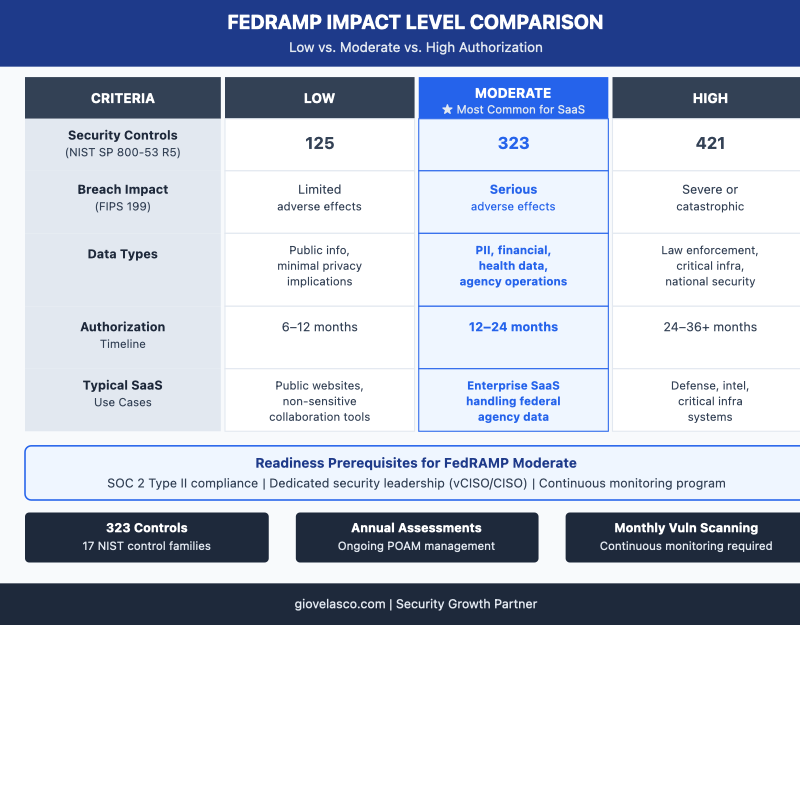
Low impact applies to systems where a breach would have limited adverse effects on organizational operations, individuals, or national interests. Moderate impact applies where a breach would have serious adverse effects — significant financial loss, harm to individuals, or impairment of organizational mission capabilities. High impact applies where a breach could have severe or catastrophic effects.
What FedRAMP Moderate Authorization Actually Requires
FedRAMP Moderate authorization requires documented implementation and independent assessment of 323 security controls drawn from NIST SP 800-53 Revision 5. These controls span 17 control families: Access Control, Awareness and Training, Audit and Accountability, Assessment and Authorization, Configuration Management, Contingency Planning, Identification and Authentication, Incident Response, Maintenance, Media Protection, Physical and Environmental Protection, Planning, Personnel Security, Risk Assessment, System and Services Acquisition, System and Communications Protection, and System and Information Integrity.
The breadth of this control set reflects the sensitivity of the data that Moderate-impact systems handle. Unlike SOC 2, where the scope and criteria can be tailored to a specific service, FedRAMP Moderate authorization requires implementation across the full control baseline — there is no tailoring of the control set itself, though there is some flexibility in how certain controls are implemented.
FedRAMP Moderate Authorization: Key Differences from Low
FedRAMP Low authorization requires implementation of 125 controls — roughly 38 percent of the Moderate baseline. The difference is not just quantitative. Moderate adds substantially more rigorous requirements in several areas.
Access control requirements at Moderate include more detailed session management, more restrictive remote access controls, and stronger requirements for privileged access management. Configuration management at Moderate requires more comprehensive change control documentation and more frequent configuration scanning. Contingency planning at Moderate requires more detailed recovery procedures and more frequent testing.
The practical implication is that an organization that has completed FedRAMP Low authorization has a significant head start on Moderate — but should not underestimate the additional 198 controls and the increased rigor in the shared control categories.
Which Federal Use Cases Require Moderate vs Low Authorization
Understanding which impact level applies to your specific federal use case is critical before investing in the authorization process. The determination is made by the federal agency, not by the vendor — but you can evaluate likely impact levels based on the data types your service handles.
FedRAMP Low typically applies to systems handling publicly available information or information with minimal privacy implications — publicly accessible websites, collaboration tools used for non-sensitive communication, or productivity software with no federal data processing.
FedRAMP Moderate applies to systems handling personally identifiable information, financial data, health information, or any information where a breach could harm individuals or impair agency operations. The majority of enterprise SaaS applications handling federal agency data fall into the Moderate category. FedRAMP High applies to systems handling law enforcement data, critical infrastructure information, or information whose compromise could cause severe damage — most commercial SaaS companies do not pursue High authorization.
How to Know If Your Company Is Ready to Pursue FedRAMP Moderate
FedRAMP Moderate authorization is a multi-year commitment that requires a mature security foundation before the formal authorization process begins. The organizations that complete the process efficiently are those that enter it with three things already in place.
The first is an existing compliance program — ideally SOC 2 Type II. The overlap between SOC 2 controls and the lower-risk NIST 800-53 control families is substantial, meaning a SOC 2-compliant organization has addressed a significant portion of the Moderate control baseline before starting FedRAMP preparation. For context on how vCISO services accelerate this process, see our post on vCISO services for SaaS companies.
The second is dedicated security leadership. FedRAMP Moderate authorization requires a System Security Plan authored and maintained by a named security owner. A fractional or full-time CISO with FISMA and NIST framework experience is the minimum staffing requirement for a realistic authorization program.
The third is organizational commitment to continuous monitoring. FedRAMP Moderate authorization is not completed once — it requires annual assessments, monthly vulnerability scanning, and ongoing Plan of Action and Milestones management. Organizations that evaluate FedRAMP as a project rather than a program consistently underestimate this ongoing obligation.
Evaluating FedRAMP Moderate authorization for your SaaS company? A gap assessment against the NIST 800-53 Moderate baseline gives you a realistic picture of your starting point. Book a free strategy call at giovelasco.com/contact.
— Giovanni Velasco · CISSP · Security Growth Partner · giovelasco.com