
The federal government spends more than $100 billion on technology each year, and a growing portion of that spending goes to cloud-based SaaS products. If your company serves or plans to serve federal agencies, one requirement stands between your product and that market: FedRAMP for SaaS companies. Understanding what the program requires — and how to prepare for it — is increasingly a strategic decision, not just a compliance one.
This post explains what FedRAMP is, why it exists, what the authorization process looks like, and how SaaS companies at different stages should think about pursuing it.
What FedRAMP Is and Why the Federal Government Requires It
FedRAMP stands for the Federal Risk and Authorization Management Program. It is a government-wide program that standardizes the security assessment, authorization, and continuous monitoring of cloud products and services used by federal agencies.
Before FedRAMP existed, each federal agency conducted its own security assessment of every cloud vendor it considered. The process was duplicative, inconsistent, and expensive for both agencies and vendors. FedRAMP created a “do once, use many times” model — a vendor that completes FedRAMP authorization can offer its authorization package to any federal agency, eliminating the need for repeated individual assessments.
For SaaS companies, this means that FedRAMP authorization is effectively a prerequisite for selling to federal agencies. Without it, an agency cannot legally procure your product — regardless of how good it is or how competitive your pricing is. The authorization is the market entry requirement.
What FedRAMP Actually Evaluates
FedRAMP uses the NIST SP 800-53 control framework as its foundation. Depending on the sensitivity of the data your product handles, your authorization falls into one of three impact levels: Low, Moderate, or High.
Most commercial SaaS companies pursuing FedRAMP for the first time target Moderate impact, which covers the majority of federal agency use cases involving sensitive but unclassified information. A Moderate authorization requires documented implementation of over 300 security controls across 17 control families — covering everything from access control and incident response to physical security and supply chain risk management.
The breadth of this requirement is what makes FedRAMP a multi-year program for most organizations, not a project you complete in a quarter. The controls are not simply documented — they must be implemented, tested, and evidenced in a System Security Plan that a Third Party Assessment Organization, known as a 3PAO, reviews and validates.
The Three Phases of FedRAMP Authorization
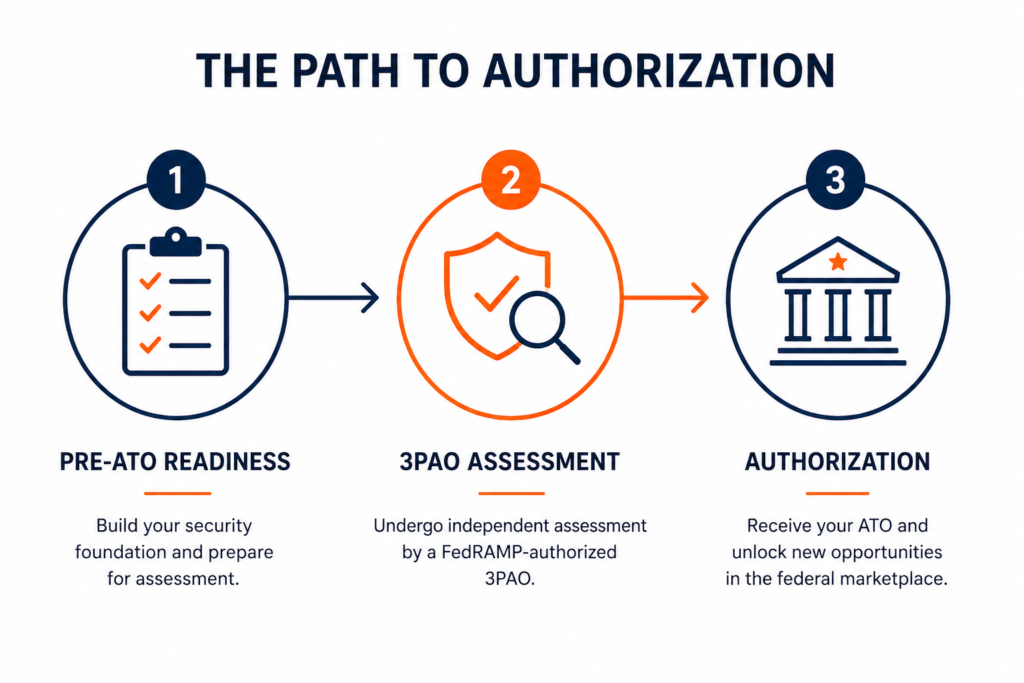
FedRAMP authorization follows a defined path regardless of which agency or authorization pathway a vendor pursues.
The first phase is pre-authorization readiness. This is where the real work happens — and where most organizations underestimate the investment required. Pre-authorization readiness involves mapping your current security controls against NIST 800-53, identifying and closing gaps, developing your System Security Plan, implementing continuous monitoring procedures, and preparing the documentation package that will be reviewed by your 3PAO. This phase typically takes 12 to 24 months for organizations starting from scratch.
The second phase is the 3PAO assessment. An accredited Third Party Assessment Organization conducts an independent evaluation of your controls as documented and implemented. They test, validate, and produce a Security Assessment Report. This phase typically takes three to six months and is heavily dependent on how complete your documentation and implementation are when it begins.
The third phase is authorization. Your package — the System Security Plan, Security Assessment Report, and Plan of Action and Milestones — is reviewed by either a sponsoring agency or the FedRAMP Program Management Office, depending on your authorization pathway. Authorization can take six to twelve additional months.
FedRAMP for SaaS: Choosing the Right Authorization Pathway
There are two primary pathways to FedRAMP authorization. The Agency pathway requires you to identify a federal agency willing to sponsor your authorization — the agency reviews your package and issues an Authorization to Operate (ATO). The JAB pathway, used for products with broad federal applicability, involves review by the Joint Authorization Board representing the three largest federal agencies.
For most SaaS companies pursuing FedRAMP for the first time, the Agency pathway is the practical starting point. It requires building a relationship with an agency that has a use case for your product and is willing to invest in the authorization process alongside you. That relationship is often the hardest part of the journey — the technical work is challenging but predictable.
Is Your Company Ready to Pursue FedRAMP
FedRAMP authorization requires meaningful organizational investment. Before committing to the process, SaaS companies should evaluate whether the market opportunity justifies the cost and timeline.
On the cost side, a realistic estimate for a first-time Moderate authorization — including pre-authorization preparation, 3PAO assessment fees, and internal resource allocation — ranges from $500,000 to $2 million over the two to three-year timeline. Ongoing annual costs for continuous monitoring add $200,000 to $500,000 per year after authorization.
On the opportunity side, the federal market is substantial and sticky. Once authorized, your product can be procured across all federal agencies without additional authorization. Federal contracts tend to be multi-year, high-value, and low-churn. For the right product in the right category, the investment case is clear.
The organizations best positioned to pursue FedRAMP successfully are those that already have a mature security program — ideally with SOC 2 Type II in place — and a specific federal agency relationship or pipeline that justifies the investment.
If you’re evaluating FedRAMP for your SaaS company, start with a gap assessment against NIST 800-53 Moderate controls. Book a free 30-minute strategy call at giovelasco.com/contact to understand your starting point before committing to the process.
What to Do Before You Start FedRAMP for Saas Preparation
The companies that move through FedRAMP fastest are the ones that begin the process with a strong security foundation already in place. SOC 2 Type II is the most effective starting point — the controls required for SOC 2 overlap significantly with the lower-risk NIST 800-53 control families, meaning companies with an existing SOC 2 program have already completed 30 to 40 percent of the FedRAMP control work before they start.
Beyond SOC 2, the critical pre-requisites are a documented System Security Plan outline, a named security leadership function — either a full-time CISO or a credentialed fractional CISO — and a clear organizational commitment to the continuous monitoring obligations that come with authorization.
FedRAMP for SaaS companies is not a project with a defined end date. It is a continuous compliance program that requires sustained investment. Organizations that understand this before they start are the ones that complete the process.