
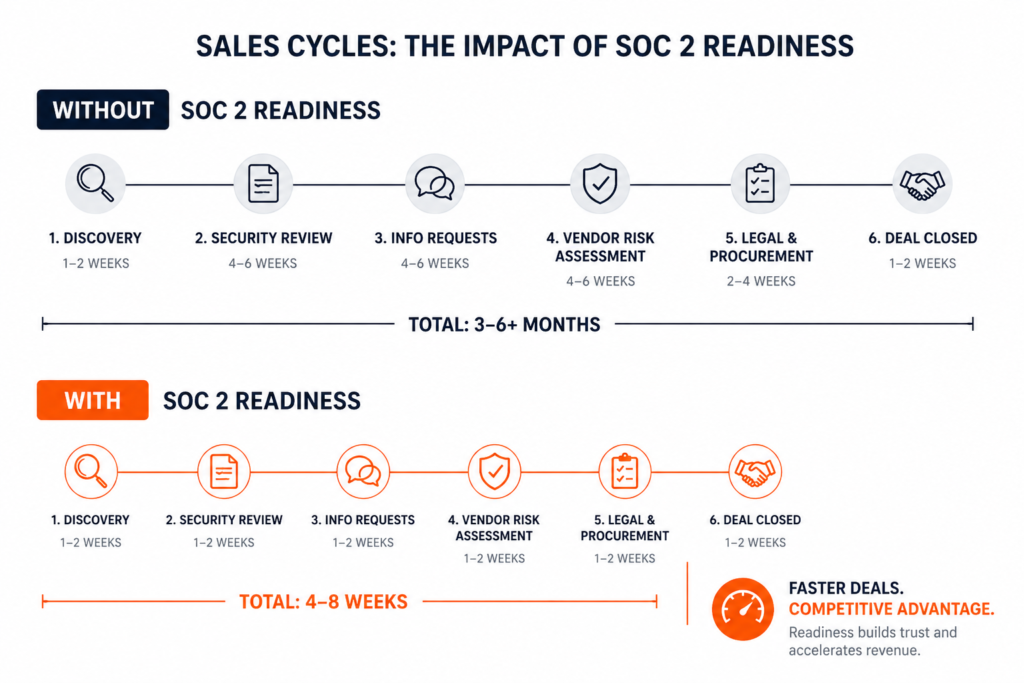
Enterprise procurement teams do not close deals on faith. When your sales team reaches the contract stage with a mid-market or enterprise buyer, a vendor security review lands in the conversation — and how prepared your organization is determines whether that review takes three days or three months. SOC 2 readiness is the single most effective lever a B2B SaaS company has to compress that timeline and keep deals moving.
This post explains exactly how readiness reduces friction in enterprise sales cycles, what procurement teams see when they review an unprepared vendor, and what the path to audit-ready looks like for a company at your stage.
What Enterprise Procurement Teams Actually Evaluate
When a large enterprise considers a new SaaS vendor, the buying decision involves more than the product team. Legal reviews the contract. IT or information security reviews the vendor’s risk posture. A security team evaluates your controls. Each of those stakeholders has the ability to stall or kill the deal.
The IT and security reviewers are not evaluating whether your product is good. They are evaluating whether onboarding your product creates a manageable or unacceptable risk for their organization. A company with SOC 2 readiness documentation moves through that evaluation quickly. A company without it becomes a custom investigation.
Custom investigations take time. They generate questionnaires. They require your engineering team, your legal team, and your CTO to spend hours answering the same questions that a SOC 2 Type II report would have answered automatically. For a growing SaaS company, that time has a cost — and it compounds across every deal in your pipeline.
How SOC 2 Readiness Compresses Deal Timelines
SOC 2 readiness changes the procurement dynamic in three concrete ways.
First, it answers most vendor security questionnaires automatically. A standard enterprise security questionnaire runs between 80 and 200 questions. A SOC 2 Type II report satisfies 80 to 90 percent of those questions with a single document. What used to take three weeks of back-and-forth can happen in 24 hours.
Second, it eliminates the “pending security review” stall. Without a SOC 2 report, your deal sits in a queue while the buyer’s security team schedules time to investigate your environment. With a report, you move to contract review. The queue disappears.
Third, it signals organizational maturity. Enterprise buyers are not just buying your product — they are evaluating whether your company is a responsible custodian of their data. A SOC 2 Type II report from an accredited auditor is the most credible signal you can provide. It tells the buyer that an independent third party reviewed your controls and found them adequate. That signal accelerates trust, and trust accelerates deals.
The Real Cost of an Unready Security Program
The most dangerous aspect of an unprepared security posture is that its cost is invisible. Deals that stall because of a vendor security review rarely appear in the CRM with the note “lost due to missing SOC 2 report.” They show up as “no decision,” “went with competitor,” or “budget timing.” Nobody ever captures the actual cause.
For a SaaS company with an average contract value of $50,000, a single enterprise deal that stalls for six weeks and then fails to close represents more than the cost of an entire SOC 2 readiness program. And that calculation applies to every deal in your pipeline where a security review is triggered — which, for companies selling to mid-market and enterprise buyers, is most of them.
The math is straightforward. The challenge is that founders typically do not recognize the pattern until they have paid the cost two or three times.
SOC 2 Readiness Is Not Just About the Audit
A common misconception is that SOC 2 readiness begins when you engage an auditor. In reality, the work that determines how fast your audit goes — and how many findings you receive — happens in the months before the auditor arrives.
Readiness means your policies are documented and current. It means your access controls are not just implemented but evidenced with logs and access review records, and your incident response plan has been tested, not just written. It also means your vendor inventory exists and your third-party agreements include security requirements.
When these things are in place before an auditor shows up, the audit becomes a validation exercise. When they are not, the audit becomes a remediation project — and remediation projects are expensive, slow, and disruptive to your engineering and operations teams.
What SOC 2 Readiness Looks Like at Your Stage
For a B2B SaaS company with between 20 and 100 employees, SOC 2 readiness is achievable in three to six months with the right structure. The process has three phases.
The first phase is a gap assessment — an honest evaluation of where your current controls stand against the criteria an auditor will apply. This tells you what you have, what needs to be documented, and what needs to be built. Without this step, companies routinely discover major remediation work mid-audit.
The second phase is remediation and documentation — building the policies, procedures, and evidence artifacts that close the gaps identified in the assessment. This is where most of the work happens, and where having experienced guidance matters most.
The third phase is the audit itself — typically a 12-month observation period for a Type II report, during which an accredited auditor evaluates whether your controls operated consistently. Companies that complete the first two phases thoroughly move through the audit with minimal findings.
Download the free 70-Point Enterprise Security Readiness Assessment at giovelasco.com/guide to see where your program stands today — across the exact control areas your next enterprise buyer will evaluate.
How to Know If Your Company Is SOC 2 Ready
The fastest way to answer this question is a structured gap assessment. Before you engage an auditor, before you budget for a compliance platform, and before you start building documentation, you need to know where you actually stand.
That means looking at your current policies, access controls, change management practices, incident response procedures, and vendor management against the criteria a SOC 2 auditor will use. Most founders are surprised by what they find — not because their security is poor, but because it is undocumented, informal, or inconsistently applied.
SOC 2 readiness is not about having perfect security. It is about having documented, practiced, and evidenced security. An auditor can only evaluate what exists on paper and in logs. A strong security culture that has never been formalized will generate findings. A documented program that is consistently followed will not.