
The Assumption That Keeps Founders From Acting
When a B2B SaaS founder hears ‘you need a security program,’ the mental image that often follows is a full-time Chief Information Security Officer — someone with a $200,000 to $350,000 base salary, a team of analysts, a dedicated security toolset, and a quarterly board reporting schedule. For a company at $3M to $10M ARR, that picture feels like something for a later stage of growth. A virtual CISO for SaaS is the model that closes this gap — delivering enterprise-grade security governance without the full-time hire that most early-stage companies cannot yet justify.
This assumption is one of the most costly misconceptions in the early-stage SaaS market — not because the assumption is entirely wrong, but because it causes founders to delay building a security program until they can afford the full-time hire, by which point the organization has accumulated significant compliance debt and missed enterprise deals that required security documentation they didn’t have.
The reality is that the governance and strategic oversight that a full-time CISO can provide — for most early-stage companies — can be delivered through a well-structured fractional engagement. And the companies that understand this are consistently better positioned in enterprise sales cycles than their peers.
What a CISO Actually Does
Before evaluating whether a fractional model works, it is worth being precise about what a Chief Information Security Officer does versus what people assume they do.
Most founders assume the CISO role is primarily technical — managing firewalls, reviewing code, and running penetration tests. In practice, at a mature organization, a CISO spends the majority of their time on governance, risk management, vendor oversight, policy ownership, audit management, board and executive reporting, and strategic alignment between security programs and business objectives.
The hands-on technical security work — vulnerability scanning, incident triage, security architecture review — is typically delegated to a security engineering team or outsourced to managed security service providers. The CISO function is organizational leadership and accountability, not daily technical execution.
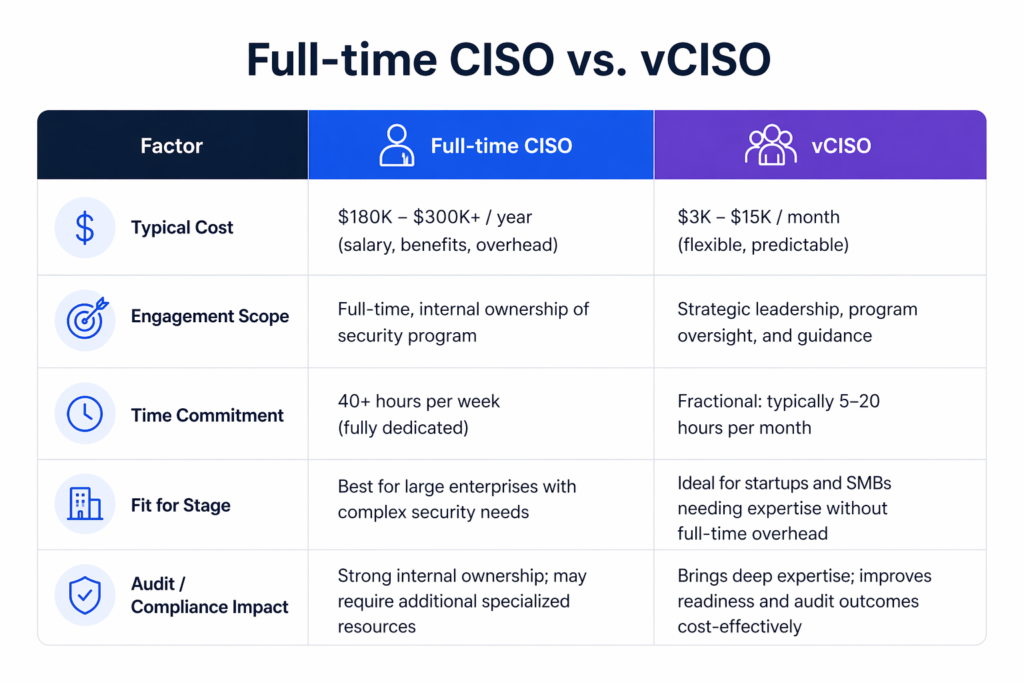
For a SaaS company at the $3M to $15M ARR stage, the governance and accountability function is exactly what you need to satisfy enterprise buyers. It is also exactly what does not require 40 hours per week.
The vCISO Model: What It Is and What It Is Not
A virtual CISO for SaaS (vCISO) is a security leadership engagement delivered on a part-time, fractional basis. The name varies — some practitioners use fractional CISO, advisory CISO, or outsourced CISO — but the core model is consistent: an experienced security professional provides strategic security leadership and oversight of compliance programs for a defined number of hours per month under a retainer arrangement.
What a virtual CISO for SaaS engagement typically covers:
- Security program design and governance — building the policies, controls, and processes that an auditor or enterprise reviewer will evaluate
- Compliance readiness and audit management — owning the SOC 2, ISO 27001, or other certification process from gap assessment through issued report
- Vendor security oversight — maintaining and reviewing the third-party risk program
- Incident response planning and tabletop exercises — building and testing the program before it is needed
- Executive and board communication — providing security risk reporting in business terms
- Enterprise sales support — responding to security questionnaires, joining due diligence calls, and presenting compliance credentials to buyers
What a vCISO engagement does not replace: a full-time security engineering function for companies with complex infrastructure and dedicated security tooling requirements. At the stage where you have a SOC team, a dedicated cloud security architecture function, and a red team, you likely need full-time security leadership. Most SaaS companies at $3M to $30M ARR are not at that stage.
If you need more information about SOC2 reports, you can check this article.
Why the Credential and Experience Level of the vCISO Matters Significantly
Not all fractional security engagements are equal. The value of a virtual CISO for SaaS engagement to an enterprise buyer depends heavily on the credentials and experience behind the engagement — specifically, whether the person providing it has operated at the level of accountability they are representing.
There is a material difference between a security consultant who has advised on compliance programs and a security leader who has been held accountable for fielding banking-grade vendor audits on behalf of clients — the person in the room when a Tier 1 financial institution’s security team runs a comprehensive vendor review, with full organizational responsibility for the outcome.
Enterprise buyers recognize this difference. A vCISO engagement backed by genuine enterprise security accountability experience — CISSP certification, leadership of programs serving regulated industries, hands-on audit management — carries authority that a junior compliance consultant does not. When you present your security program to an enterprise buyer, the person standing behind that program matters.
What Your Enterprise Buyers Are Actually Evaluating
When a sophisticated enterprise buyer reviews your vendor security documentation, they are not just looking at the contents of the report. They are evaluating whether your organization has professional security leadership. A named, credentialed security advisor associated with your program is a signal they recognize — and one that meaningfully shifts your risk tier in their assessment.
Three Scenarios Where a vCISO Engagement Accelerated Enterprise Deals
Scenario One: The Compliance Gap That Wasn’t a Blocker
A SaaS company in the HR technology space had an enterprise prospect that required SOC 2 Type II. The company had a reasonable security program, but no audit history. Rather than losing the deal, they engaged a vCISO to lead a rapid gap assessment, build the remaining policy documentation, and join the prospect’s vendor security review call as the company’s named security advisor. The deal closed on the original timeline, with a commitment to provide the Type II report within 12 months — a commitment the vCISO was accountable for delivering.
Scenario Two: The Renewal That Almost Became a Churn
An enterprise client notified a SaaS vendor that its annual vendor review had been elevated from standard to enhanced — a higher-scrutiny tier that required documented evidence of control operation and a named security contact. Without internal security leadership, the vendor had no clear point of accountability. A vCISO engagement was structured in time for the review, the documentation was organized and presented by the vCISO directly, and the renewal was completed without incident. The contract value increased in the same cycle.
Scenario Three: The Enterprise RFP With a Security Scoring Component
A SaaS company responding to a large government contractor RFP encountered a security questionnaire section weighted at 20 percent of the total evaluation score. With a vCISO leading the response — drawing on enterprise audit experience to answer questions with the specificity and authority the evaluation rubric rewarded — the company scored in the top tier of the security section. Their competitors, responding without dedicated security leadership, did not.
When Does a Full-Time CISO Actually Make Sense?
For clarity: there is a point at which a full-time security leadership hire is the right decision. That point is typically when your organization crosses two or more of these thresholds: over 100 employees, over $25M ARR with a significant enterprise customer base, operation in a regulated industry with direct compliance obligations (HIPAA, FedRAMP, PCI DSS), or a security program that requires daily operational oversight rather than strategic governance.
Before those thresholds, the fractional model typically delivers comparable compliance and sales outcomes at 20 to 30 percent of the cost, with the added advantage that the right vCISO brings experience across multiple organizations and audit contexts that an in-house hire at the same compensation level rarely matches.
Start With Clarity on Your Current Security Posture
Whether you are evaluating a full-time hire, a fractional engagement, or building the program internally, the foundation is the same: an honest, structured assessment of where your organization stands today. The 70-Point Enterprise Security Readiness Guide at giovelasco.com/guide gives you that starting point. Download it free at giovelasco.com/guide.