
Why SOC 2 Security Policies Are the Starting Point — Not the End Point
SOC 2 security policies for SaaS are the first thing an auditor requests and the most common reason first-time audits get delayed, scoped back, or generate findings that could have been avoided entirely. It is also one of the most common sources of delays, scope revisions, and last-minute remediation work. Not because policies are complex to write — they are not — but because most early-stage SaaS companies have never formalized them.
There is an important distinction to establish before going through the list: a policy is only as useful as its implementation. An auditor evaluating your SOC 2 compliance is not grading your writing. They are determining whether the policies you describe are actually reflected in your operations. A well-written policy that is not followed is a finding, not a safeguard.
With that in mind, here are the seven policies that need to exist — and be operationalized — before you engage an auditor. Remember that SOC 2 security policies for SaaS are key in your company’s security process.
1. Information Security Policy
This is the foundational document for your entire security program. It establishes the scope of your security obligations, defines roles and responsibilities, outlines management’s commitment to security, and serves as the governing framework for all other security policies.
What ‘implemented’ means in practice: your team has read it, a named executive or security owner has signed it, it has a defined review cycle (typically annual), and there is evidence that it was communicated across the organization — signed acknowledgments or training records, for example.
What auditors look for: a document that reflects your actual environment. If your policy references on-premise infrastructure and your entire stack is cloud-based, that inconsistency will generate a finding.
2. Access Control Policy
This policy defines how access to systems, data, and environments is granted, reviewed, and revoked. It covers role-based access assignments, privileged access management, MFA requirements, and the process for removing access when an employee leaves.
What ‘implemented’ means in practice: formal access provisioning workflows exist, quarterly or semi-annual access reviews are documented, and there is an offboarding checklist that includes system access revocation. Auditors will request evidence of completed offboarding records and access review logs.
Where most companies have gaps: accounts belonging to departed employees that were never formally deprovisioned. This is one of the most frequently cited findings in first-time SOC 2 audits.
3. Incident Response Plan
Your Incident Response Plan (IRP) defines how your organization detects, contains, investigates, and recovers from security incidents — and how you notify affected parties when required.
What ‘implemented’ means in practice: a documented process with defined roles, escalation paths, and notification timelines. Evidence that the plan has been reviewed and, ideally, tested through a tabletop exercise. A log of any incidents that have occurred and how they were handled.
Why it matters beyond compliance: enterprise buyers increasingly ask about incident notification timelines in contract negotiations. A well-documented IRP gives your legal team a defensible position and your sales team an honest answer.
4. Change Management Policy
This policy governs how changes to your production environment — code deployments, infrastructure modifications, configuration changes — are proposed, reviewed, tested, and approved.
What ‘implemented’ means in practice: a defined approval process for production changes, separation between the developer who makes a change and the person who approves it, and a record of change approvals that can be produced for an auditor. This is where many early-stage engineering teams have gaps, because the process is informal and fast-moving.
A practical starting point: formalize your deployment pipeline with required peer reviews and documented approval records. GitHub pull request workflows that require one or more approvals are a defensible starting point if your process is documented and consistently followed.
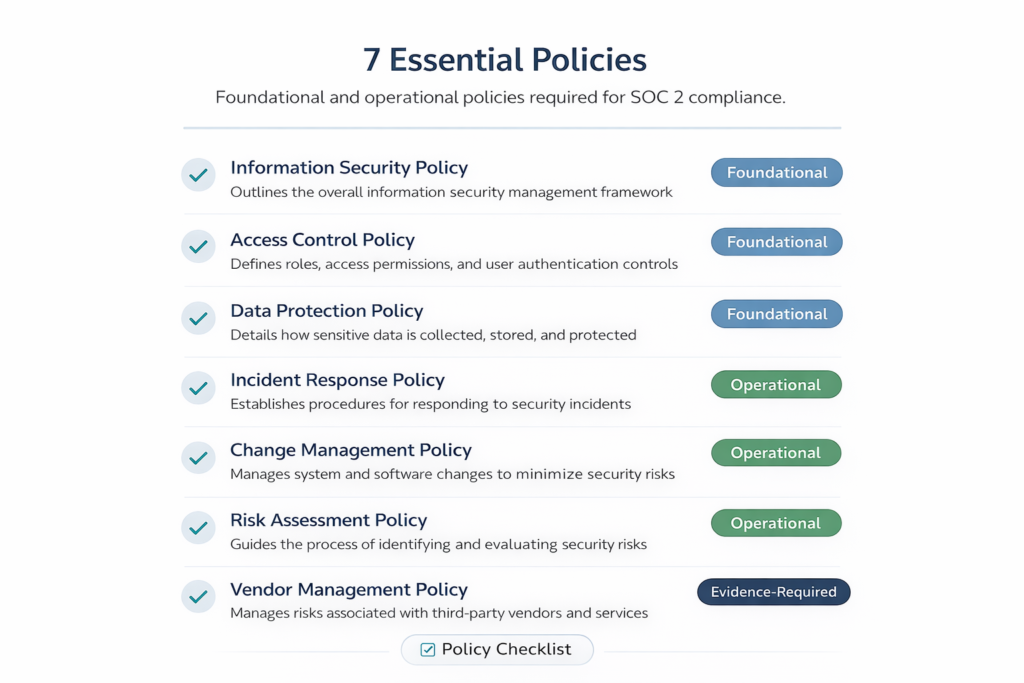
5. Data Classification and Handling Policy
This policy defines how your organization categorizes data based on sensitivity — typically public, internal, confidential, and restricted — and specifies the handling, storage, transmission, and disposal requirements for each category.
What ‘implemented’ means in practice: data in your environment is actually classified according to the policy. Customer data is handled according to the confidential or restricted tier requirements. Employees know what category applies to the data they work with daily.
Why this is often harder than it appears: many SaaS companies process multiple data types across multiple customer tenants with varying sensitivity levels. Defining and implementing a consistent classification model requires a clear view of data flows that many founders have never formally mapped.
6. Business Continuity and Disaster Recovery Plan
Your Business Continuity Plan (BCP) and Disaster Recovery Plan (DRP) address how your organization maintains operations and recovers critical systems in the event of a significant disruption — infrastructure failure, ransomware, natural disaster, or vendor outage.
What ‘implemented’ means in practice: defined Recovery Time Objectives (RTOs) and Recovery Point Objectives (RPOs) for critical systems, tested backup and restore procedures, and documented procedures for operating under degraded conditions. Auditors will ask whether you have tested your recovery procedures — and when.
A common gap: companies with excellent backup infrastructure that have never actually run a recovery test. Backups that have not been tested are not verified backups. Regulators and auditors treat untested recovery procedures as equivalent to no recovery procedures.
7. Vendor and Third-Party Management Policy
This policy defines how your organization identifies, assesses, and monitors the security posture of third-party vendors and subprocessors that have access to your systems or customer data.
What ‘implemented’ means in practice: a vendor inventory that includes all third parties with access to production or customer data, a defined process for assessing new vendors before onboarding, evidence of periodic reviews for existing vendors, and security requirements included in vendor agreements.
Why enterprise buyers care about this specifically: your vendor’s security failure becomes your customer’s problem. Enterprise procurement teams hold their SaaS vendors responsible for the security posture of the entire supply chain. A SaaS company that cannot demonstrate it manages third-party risk is a liability for any enterprise buyer operating under regulatory requirements.
The Most Important Thing to Know About Policy Documentation
The gap between ‘we have a policy’ and ‘we have an implemented, evidence-supported program’ is where the majority of first-time SOC 2 audits generate findings. Every policy on this list needs supporting evidence — records, logs, signed acknowledgments — that demonstrates it is operational, not just written SOC 2 security policies for SaaS. You can find more information about how to accomplish a sucessfull SOC 2 implementation in this article.
Where to Start When You Have None of These in Place
Build them in this order of priority, which reflects both audit impact and implementation complexity:
- Start with: Information Security Policy and Access Control Policy — these are foundational for all other controls.
- Second: Incident Response Plan — this has the highest visibility with enterprise buyers in contract negotiations.
- Third: Change Management Policy — this is where the engineering process intersects with compliance requirements.
- Alongside these, begin your vendor inventory, even if the formal Vendor Management Policy comes later.
- After the core four: Data Classification, BCP/DRP — these require more organizational input but build on the foundation established by the first four.
See Where Your Policy Gaps Are Right NowThe 70-Point Enterprise Security Readiness Guide at giovelasco.com/guide includes a dedicated section on policy documentation across all nine control categories. Use it to identify exactly which policies you have, which are documented but not operationalized, and which need to be built from scratch. Download it free at giovelasco.com/guide. This will provide a good starting point to accomplish the definition and implementation of SOC 2 security policies for SaaS