
The Distinction That Catches Founders Off Guard
When most founders first look into SOC 2, they find out quickly that there are two report types. They assume Type I is the ‘starter’ option — something you get first to satisfy buyers while you work toward Type II. In some situations, that logic holds. In others, it leads to a painful discovery mid-negotiation. The SOC 2 Type I vs Type II distinction catches founders off guard at the worst possible moment — mid-negotiation with an enterprise buyer who requires the report they don’t have.
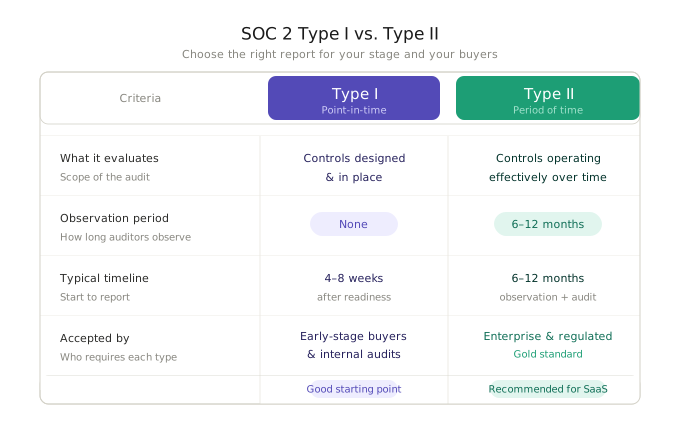
The fundamental difference is this: a SOC 2 Type I report describes whether your security controls are designed appropriately at a specific point in time. A SOC 2 Type II report evaluates whether those same controls operated effectively over a defined observation period — typically six to twelve months.
That distinction is not just technical. To enterprise buyers, it is the difference between a company that wrote the right policies on paper and a company that demonstrably lives by them. Those are not the same thing, and experienced procurement teams know it.
SOC 2 Type I vs Type II: A Closer Look at Each Report
SOC 2 Type I — Point-in-Time Design Evaluation
A Type I audit is conducted on a single date. The auditor reviews your security policies, procedures, and control documentation and issues an opinion on whether those controls are suitably designed to meet the applicable Trust Service Criteria.
What it takes to complete: documentation of controls, evidence of system configurations, and policy documents. The auditor is not looking at logs over time, not testing whether controls were followed consistently, and not evaluating operational effectiveness. They are reviewing your blueprint.
Timeline from initiation to issued report: typically three to five months, depending on the organization’s state of readiness.
Where it satisfies buyers: smaller buyers, some mid-market procurement teams, certain international buyers who are less familiar with the US SOC framework, and buyers who explicitly accept Type I during a pilot or early-stage contract period.
SOC 2 Type II — Operational Effectiveness Over Time
A Type II audit covers an observation period — most commonly twelve months for a standard annual audit, though six-month reports are common for first-time audits. During this period, the auditor is not just reviewing documentation. They are testing whether the controls you described actually operated as described, consistently, throughout the period.
What that testing looks like in practice: auditors pull access logs, review user provisioning and deprovisioning records, examine change management tickets, test incident response documentation, and verify that security awareness training records exist for all employees. They are looking for evidence of operation, not just evidence of intent.
Timeline from initiation to issued report: twelve to sixteen months for a full-period Type II. Six to nine months for a shorter observation window for the first-time report.
Where it satisfies buyers: virtually all enterprise buyers. Financial services, healthcare, and government buyers typically require Type II specifically in their vendor agreements. Mid-market buyers increasingly default to requiring it as well.
The Misconception That Costs Founders Time
The most common — and most costly — misconception is that a Type I report satisfies most enterprise buyers as a stepping stone. In practice, the procurement and legal teams at companies with 1,000 employees typically have standard vendor agreement language that specifically requires a SOC 2 Type II report. Type I is not a substitute, and submitting it in response to a Type II request will typically generate a follow-up from the buyer’s security team.
This does not mean Type I has no value. It means founders need to understand their actual buyer profile before committing to a Type I timeline. If your pipeline is primarily mid-market buyers with $200M to $1B in revenue, you will face Type II requirements on most material contracts. Starting with Type I as a temporary strategy is a legitimate bridge — but only if you build the Type II program simultaneously.
The Bridge Strategy That Actually Works
Begin the Type II observation period immediately after your Type I audit closes. Many organizations issue a Type I report as a proof of control design, then begin the observation period simultaneously. This means you can present the Type I report to prospects immediately while your Type II audit period is already underway — reducing the total elapsed time to a full Type II by as much as four months.
Cost Differences: What to Budget For
The cost difference between Type I and Type II reflects the difference in auditor time and evidence review scope.
For an early-stage SaaS company with a focused scope (Security criterion only, limited system boundaries):
- SOC 2 Type I: $12,000 to $25,000 in auditor fees, depending on firm size and system complexity
- SOC 2 Type II (first year): $20,000 to $40,000 in auditor fees for comparable scope
- SOC 2 Type II (renewal, years 2+): $15,000 to $30,000 as controls mature and evidence collection becomes routine
These ranges exclude the cost of any compliance automation platforms, which run $15,000 to $30,000 annually for tools like Vanta or Drata. External consultant or vCISO fees for preparation work are also separate. The complete first-year investment for a well-run program typically falls between $40,000 and $80,000 for a focused SaaS audit, depending on the organization’s starting point.
How to Know Which One You Need Right Now
The fastest way to answer this question is to look at your active pipeline and your top five target accounts. Review their vendor agreement language, their publicly stated vendor security requirements, or simply ask your champion directly: Does your procurement team require a SOC 2 Type II specifically, or will Type I satisfy your current review?
Most champions will tell you the truth. And most of the time, for enterprise deals you actually care about closing, the honest answer is Type II.
Know Your Gap Before Committing to a Timeline
The 70-Point Security Readiness Guide at giovelasco.com/guide gives you a clear-eyed assessment of how prepared your organization is for either audit type. Understanding your current control gaps is the most important factor in setting a realistic timeline — and a realistic budget. Download it at giovelasco.com/guide.
[…] Why Enterprise Buyers Require ItProcurement and legal teams at enterprise companies can’t evaluate every vendor’s security posture from scratch. A SOC 2 Type II report from an accredited auditor is the shorthand they rely on to make vendor decisions at scale. Without it, you become a liability in their risk register — not a partner. for this block. Use this space for describing your block. Any text will do. Description for this block. You can use this space for describing your block.Check this article to know the diference between type I and type II reports. […]
[…] The gap between ‘we have a policy’ and ‘we have an implemented, evidence-supported program’ is where the majority of first-time SOC 2 audits generate findings. Every policy on this list needs supporting evidence — records, logs, signed acknowledgments — that demonstrates it is operational, not just written SOC 2 security policies for SaaS. You can find more information about how to accomplish a sucessfull SOC 2 implementation in this arti…. […]
[…] If you need more information about SOC2 reports, you can check this article. […]
[…] fastest are the ones that begin the process with a strong security foundation already in place. SOC 2 Type II is the most effective starting point — the controls required for SOC 2 overlap significantly with […]
[…] things happened in the same quarter. A healthcare organization in advanced discussions asked for a SOC 2 Type II report. And a financial services firm requested their standard vendor security questionnaire — 180 […]